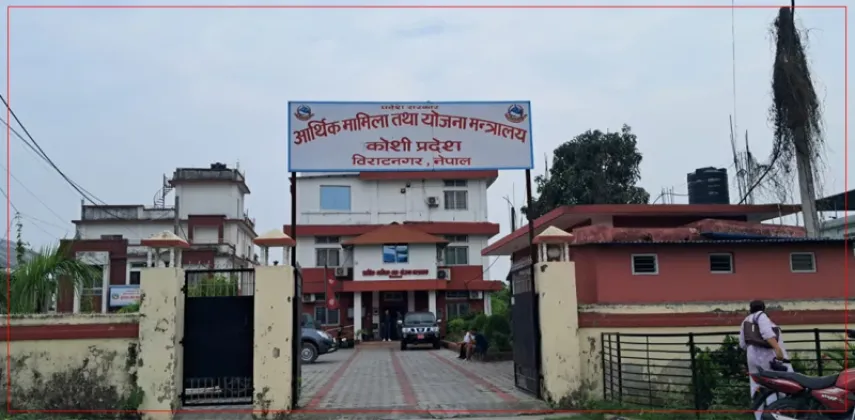
The Koshi Province government collected about 9 billion rupees in revenue in the first four months (Shrawan to Kartik) of the current fiscal year 2083/84, with internal revenue rising by a striking 85 percent, according to data published by the province's Ministry of Economic Affairs and Planning. However, the encouraging income figures stand in sharp contrast to the province's weak spending performance, as development expenditure during the same period stood at only 5 percent of the budgeted amount.
The data, reported from Kathmandu and Biratnagar on November 29, 2026, paints a picture of a province that has been increasingly successful in mobilizing its own resources but continues to struggle in converting available funds into actual development activity on the ground. The imbalance between strong revenue collection and sluggish expenditure has once again highlighted the persistent implementation challenges facing provincial governments in Nepal.
Strong Internal Revenue Growth
The headline figure of roughly 9 billion rupees in total revenue collected over Shrawan, Bhadra, Ashoj and Kartik reflects a healthy start to fiscal year 2083/84 for the province. What stands out most in the ministry's data is the performance of internal revenue, which grew by 85 percent compared to the corresponding period of the previous fiscal year.
Internal revenue refers to the income the provincial government raises through its own sources, including taxes, fees, charges and other provincial-level levies, rather than relying solely on federal transfers and revenue sharing. An 85 percent jump in this category suggests that Koshi Province has been able to significantly expand its own resource mobilization base, a key indicator of fiscal strength for subnational governments operating under Nepal's federal structure.
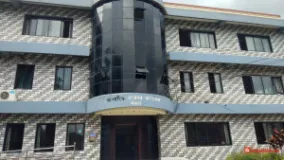
The figures were compiled and published by the province's Ministry of Economic Affairs and Planning, which oversees budget implementation and tracks revenue and expenditure performance across the provincial government's agencies.
Spending Capacity Remains Weak
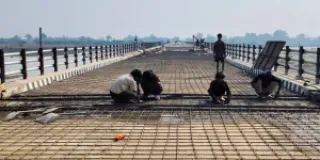
Despite the encouraging income side of the ledger, the expenditure picture tells a very different story. Development expenditure, the spending that directly funds infrastructure projects, programs and services, reached only 5 percent of the budgeted amount in the first four months of the fiscal year.
This means that while the province has been collecting money at an accelerating pace, it has released and spent very little on the development priorities set out in its annual budget. Such low capital spending in the first third of the fiscal year is a familiar pattern in Nepal's public finance system, where procurement delays, slow project preparation and administrative bottlenecks often push the bulk of development spending into the final months of the fiscal year.
The contrast is particularly stark because provincial governments' development budgets are meant to deliver local infrastructure and services, from roads and buildings to agricultural and tourism programs, and low early spending typically translates into incomplete projects and rushed year-end expenditure.
What the Numbers Mean
The combination of rising internal revenue and stalled development spending underscores a recurring dilemma in Nepal's federal experiment: growing fiscal capacity has not been matched by commensurate fiscal delivery. For Koshi Province, the strong 85 percent growth in internal revenue demonstrates that the province's own-source income base is expanding rapidly, which strengthens its financial autonomy and reduces dependence on grants from the federal government.
Yet the ability of a government to deliver on its budget commitments depends as much on spending execution as on revenue collection. With development expenditure at just 5 percent four months into the fiscal year, the province faces the risk that its ambitious development plans, however well funded on paper, may not reach the intended beneficiaries within the fiscal year.
The Ministry of Economic Affairs and Planning's release of these figures provides an early warning signal for provincial policymakers. If the current spending trajectory continues, the province may need to intensify project readiness reviews, streamline procurement processes and strengthen coordination with implementing agencies to ensure that the revenue windfall is converted into tangible development outcomes.
Outlook for the Fiscal Year
As fiscal year 2083/84 progresses, the focus for Koshi Province will be on whether it can translate its improved revenue performance into stronger expenditure execution in the remaining eight months. Provincial budgets in Nepal typically see spending accelerate sharply in the second half of the fiscal year, but relying on a late spending surge often undermines project quality and value for money.
The data for Shrawan to Kartik offers both reassurance and concern: reassurance that the province's revenue machinery is performing well, and concern that its implementation machinery is lagging far behind. How the Biratnagar-based provincial government responds in the months ahead will determine whether fiscal year 2083/84 becomes a year of genuine development delivery or another cycle of underspent budgets despite growing income.