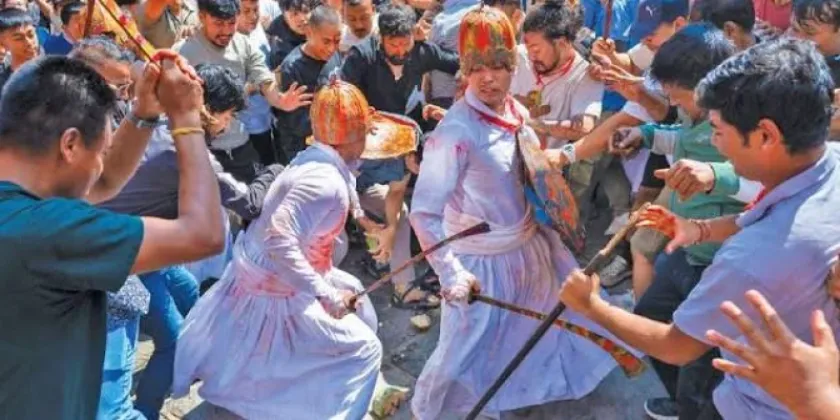
The Khā Pihāwaigu Jātrā, a festival reenacting Malla-era warfare, was held in Madhyapur Thimi, Bhaktapur, on Thursday, marking Ekadashi of the bright fortnight of Asoj. Participants carried swords, khukuris, shields and battle armour from the Dyo Chhen of Taleju Bhavani at Layku, the former royal palace, while Guthiyars demonstrated traditional martial skills in neighbourhoods across the town.
A procession through the town
The festival’s route followed customary paths through both the upper and lower parts of Madhyapur Thimi. According to tradition, the procession passed through Inayetol and Duipokhari before reaching Digu Bhairav in the upper town. In the lower town, it went through Dathutol. The route connected neighbourhoods with the town’s ceremonial observance and brought different communities associated with the palace into the event.
The procession’s weapons and armour formed a visible part of the reenactment. Participants carried them from the Dyo Chhen of Taleju Bhavani at Layku, identified as the former royal palace. As the procession moved through the traditional route, Guthiyars displayed martial skills in various neighbourhoods, presenting the festival not only as a procession but also as a public demonstration of traditional practices.
Recalling Malla-era martial traditions
The Khā Pihāwaigu Jātrā is centred on the reenactment of warfare from the Malla period. Its use of swords, khukuris, shields and battle armour gives the observance a distinctly martial character, while the displays by Guthiyars bring traditional skills into the streets of Madhyapur Thimi. The event links those performances with a ceremonial procession beginning at the palace-associated Dyo Chhen.
The participation of communities associated with the palace is also part of the festival’s traditional form. Their involvement, alongside the route through established neighbourhoods, makes the observance a town-wide event rather than a display confined to a single site. The procession’s passage through Inayetol, Duipokhari, Digu Bhairav and Dathutol follows the customary distinction between the upper and lower town routes described for the festival.
Observance on Ekadashi of Asoj
This year’s procession took place on Ekadashi of the bright fortnight of Asoj. The date placed the festival within the town’s seasonal religious and cultural calendar, while the traditional route and martial displays shaped the day’s public observance. The reported activities included the carrying of ceremonial arms and armour, the participation of palace-associated communities and demonstrations by Guthiyars in different neighbourhoods.
Together, these elements made the Khā Pihāwaigu Jātrā a public reenactment of Malla-era warfare in Madhyapur Thimi. Its ceremonial objects, customary route and community participation brought the festival’s martial traditions into the streets of Bhaktapur’s historic town. The observance concluded with the procession passing through its traditional upper- and lower-town locations.