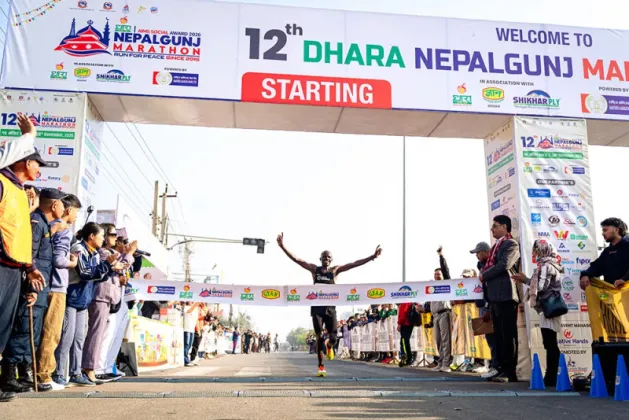
Kenyan runner Julius Muriuki captured the title at the 12th Dhara Nepalgunj Marathon on Saturday, completing the 42.195-kilometre course in 2 hours, 20 minutes and 25 seconds to become the first foreign athlete to win the event in its twelve-edition history. Muriuki collected a cash prize of two lakh rupees, or NPR 200,000, along with a winner's trophy, according to a report by Ratopati. The result marks a turning point for a race whose title, until this weekend, had never left domestic hands.
A first in twelve editions
For the first eleven runnings of the Dhara Nepalgunj Marathon, the champion's trophy stayed with home-grown athletes. Muriuki's victory on Saturday ended that streak and wrote his name into the race's record books as its first international winner. In the world of road racing, where a course record or a first-time champion can redefine an event's reputation, the significance of the milestone is hard to overstate for the Nepalgunj running community.
The race takes place in Nepalgunj, a major city in Banke district in the southwestern plains of Nepal. Hosting a full-distance marathon, contested over the classic 42.195 kilometres, gives the region a flagship long-distance event and offers runners a stage outside the country's traditional centres of road racing. Reaching a twelfth edition is itself a notable achievement for any regional race, a sign of continuity and local support across more than a decade of organising.
What the winning time means
Muriuki's finishing time of 2:20:25 is a serious mark by any standard. It works out to an average pace of roughly 3 minutes and 20 seconds per kilometre, maintained continuously for close to two and a half hours, or an average speed of just over 18 kilometres per hour. Broken down differently, that pace corresponds to an average split of around 70 minutes for each half of the marathon distance.
Times in the 2:20 bracket are typically associated with highly trained international marathoners, and Muriuki's performance reflects the calibre of athlete the Nepali race was able to attract this year. For a domestic event to be won in such a time is a statement about the standard of competition on the day, and it sets a demanding benchmark for whoever lines up at the start of the 13th edition. The initial report did not include the finishing times of the runners who followed him across the line.
Prize money heads abroad for the first time
Along with the title, Muriuki takes home a purse of two lakh rupees and a trophy, the traditional top rewards at the Nepalgunj race. His win means that, for the first time in the marathon's history, both the championship and the winner's cheque leave Nepali hands. For domestic runners who had grown accustomed to the top prize staying at home, the arrival of an international champion changes the competitive calculus of the event overnight.
Cash prizes and trophies play a central role in attracting talent to road races, and a two-lakh purse gives the Nepalgunj marathon a tangible incentive for serious athletes. Muriuki's success also demonstrates that the course and conditions in Nepalgunj can reward genuinely fast running. Whether his triumph encourages more foreign entrants in future editions will become clear only in the years ahead, but the precedent of an international winner is now firmly established.
A milestone moment for Nepalgunj and Nepali road running
The Dhara Nepalgunj Marathon, which carries the Dhara name in its title, has grown into one of the fixtures of Nepal's road running calendar across its twelve editions. Marathons of this kind serve several purposes at once: they give elite runners a competitive outlet, they encourage recreational participation in a healthy sporting culture, and they put host cities like Nepalgunj in the spotlight of the national sporting conversation.
Muriuki's win adds a new chapter to that story. A foreign champion on Nepali roads signals to the wider running world that the race is capable of hosting and crowning international-calibre performances. For the local organising community, the 12th edition will be remembered as the one when the title finally crossed borders.
For the runners of Nepalgunj and beyond, Saturday's race offers both inspiration and a challenge. The inspiration lies in the example of a winning performance executed at a relentless pace over the full marathon distance; the challenge lies in reclaiming a title that has, for the first time, gone overseas. As the race looks ahead to its 13th edition, Julius Muriuki's name will stand at the top of its roll of honour, the answer to the question of who first carried the Dhara Nepalgunj Marathon into international territory.