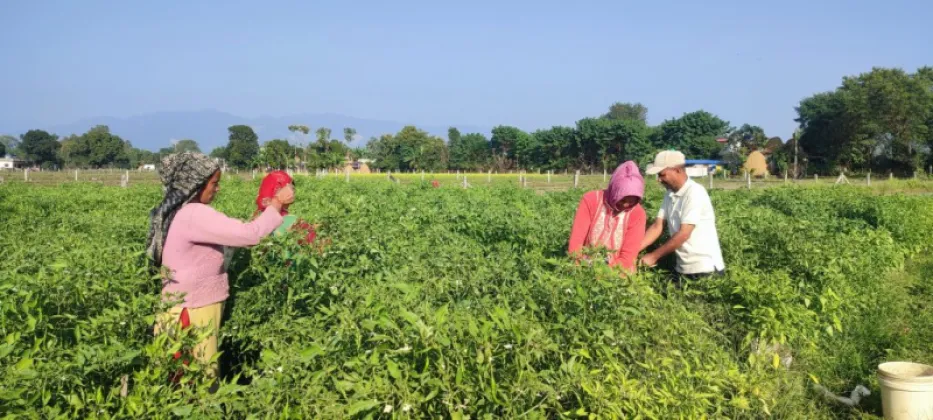
Farmers in Kanchanpur district are increasingly abandoning traditional cereal farming and turning to commercial agriculture, as vegetables, sapling production and mushroom cultivation have proven to bring substantially higher income than conventional crops. The shift, taking place across local units in the district, has encouraged many farmers to make agriculture their main occupation rather than a supplementary livelihood.
Small Investment, Big Returns
The appeal of commercial farming in the district is best illustrated by the experience of individual farmers. Birbahadur Khadka of Bhimdatta Municipality-11, Bhujela, began vegetable farming on just one kattha of land with an initial investment of only Rs 500. His first harvest alone fetched him Rs 10,000, a return that demonstrates the profit potential of vegetable cultivation compared to cereal crops.
Khadka's success reflects a wider trend among farmers in the area, who have found that small plots of land can generate meaningful income when used for commercial vegetable production. The low entry cost and quick returns have drawn more farmers into the sector, with many now treating farming not as a part-time activity but as their principal source of livelihood.
Diversification into Saplings and Mushrooms
Beyond vegetables, farmers in Kanchanpur have also diversified into sapling production and mushroom cultivation, both of which have emerged as attractive commercial ventures. Sapling production supplies seedlings to other growers, creating an additional income stream within the local agricultural economy, while mushroom farming offers high returns on limited land.
The combination of these enterprises has helped farmers become increasingly self-reliant. Instead of depending solely on the sale of staple grains, growers can now tap into multiple markets, spreading risk and boosting overall household income. This diversification has been a key factor in drawing more people into commercial agriculture in the district.
Agriculture as a Main Occupation
According to reports, many farmers in Kanchanpur have now made agriculture their main occupation, marking a significant shift in the district's rural economy. The growing profitability of vegetable, sapling and mushroom farming has given farmers a reason to invest their time and resources in their own land rather than seeking employment elsewhere.
The trend toward self-reliance through commercial farming is seen as an encouraging development for the local economy. With higher incomes from agricultural enterprises, farming families in Kanchanpur are strengthening their financial position and contributing to the growth of the district's agricultural sector.
A Model for Commercial Farming
The experience of Kanchanpur's farmers highlights how commercial agriculture can transform rural livelihoods when farmers are willing to try new crops and techniques. The shift from cereal crops to higher-value products such as vegetables, saplings and mushrooms has allowed farmers to earn substantial income from even small landholdings.
As more farmers in the district follow the example set by growers like Birbahadur Khadka, commercial farming appears set to play an increasingly important role in Kanchanpur's economy. The movement toward self-reliance through agriculture offers a promising model for other districts seeking to boost rural incomes and reduce dependence on traditional, low-yield farming practices.
Sources: Nepal Press, Ratopati, Khabarhub