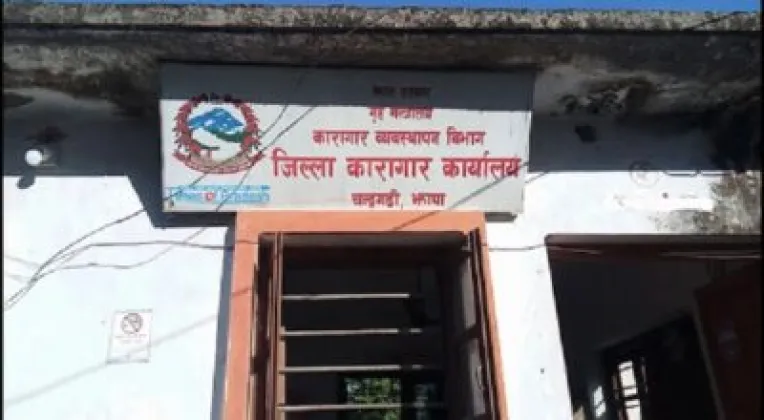
Jhapa Jail, one of the oldest correctional facilities in Koshi Province, is currently holding 1,710 people, more than twice the number it was designed to accommodate. The prison, situated in a building that is around 60 years old, has a capacity of less than half of its current population, creating severe overcrowding and forcing inmates to live in difficult and cramped conditions.
According to Jail Chief Purna Bahadur Khatri, the facility is currently holding 929 convicted prisoners and 781 detainees who are still awaiting legal proceedings. Of the total population, 1,626 are men and 84 are women. The imbalance between the jail's capacity and the number of people it must house means that both convicted prisoners and detainees are struggling to find adequate space in the rooms they are kept in.
Overcrowding Reaches Critical Levels
The situation at Jhapa Jail reflects a growing crisis of prison overcrowding in Nepal, where correctional facilities across the country regularly exceed their designed capacity. At Jhapa, the problem is compounded by the age of the infrastructure itself. The building, which has now stood for six decades, was never intended to house the kind of inmate population it currently holds.
The overcrowding leaves both convicted prisoners and those still awaiting their day in court in equally difficult circumstances. Detainees, who under law are presumed innocent until proven guilty, are confined together with convicted inmates in cramped rooms, with little room to move or rest comfortably. The sheer volume of people sharing limited space raises concerns about health, sanitation and safety within the jail.
A Facility Under Strain
Jail Chief Purna Bahadur Khatri confirmed the numbers, underscoring the scale of the challenge faced by the prison administration. With 929 prisoners and 781 detainees, the total of 1,710 people far outstrips the facility's designed capacity, which is less than half that figure. This means the jail is functioning at well over 200 percent of its intended occupancy.
The women's population stands at 84, a comparatively small but significant segment of the inmate body that also must be accommodated within the same overloaded premises. Managing the needs of such a large and mixed population, including convicted prisoners and undertrial detainees of both sexes, places considerable strain on the jail's administration, its staff and its already stretched infrastructure.
Humanitarian and Legal Concerns
The conditions described at Jhapa Jail highlight a broader concern about the rights and welfare of people in custody. Overcrowding of this magnitude affects access to adequate living space, clean surroundings and proper facilities for rest. For the 781 detainees awaiting legal proceedings, prolonged time in such conditions adds to the hardship of a justice process that has not yet reached a conclusion in their cases.
The 60-year-old structure housing the jail presents an additional challenge. Aging buildings require more maintenance, and accommodating a population more than double the design capacity accelerates wear and increases the risks associated with aging infrastructure. The prison administration in Jhapa is thus managing not only a numerical problem of too many inmates but also a structural problem of a facility that is decades past its prime.
A Reflection of a Wider Problem
While Jhapa Jail's numbers are striking, the situation is not unique to the district. Prisons across Nepal have long struggled with populations that exceed their capacity, a problem driven by a range of factors including slow judicial proceedings and high numbers of pre-trial detainees. The case of Jhapa, however, illustrates the situation starkly: nearly half of its inmates, 781 out of 1,710, are detainees whose cases are still in process.
The disclosure of these figures by the jail administration brings attention to the conditions inside a facility that most members of the public rarely see. For now, the 1,710 men and women held at Jhapa Jail continue to live within a building built six decades ago, sharing rooms far beyond what they were designed for, as both convicted prisoners and detainees wait out their time in increasingly difficult circumstances.