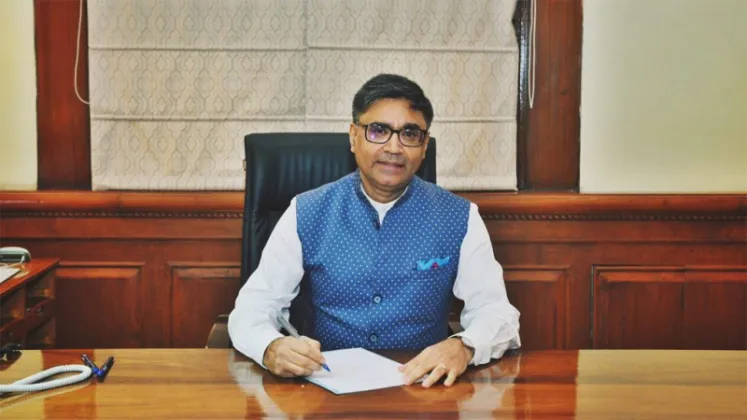
Indian Foreign Secretary Vikram Misri has dismissed the long-pending report of the Eminent Persons Group (EPG) on Nepal-India relations as "a thing of the past," effectively putting an end to any lingering hopes that New Delhi and Kathmandu might act on the recommendations of the joint study.
Misri made the remarks in response to questions from journalists at a press conference in New Delhi on Monday, held following the recent visit of Nepali Prime Minister Balendra Shah to India. His comment is widely seen as an authoritative signal that the report, which had been awaiting acceptance and implementation for years, now faces a diplomatic dead end.
What the EPG report was meant to achieve
The Eminent Persons Group was a joint mechanism established by Nepal and India to review the entire spectrum of their bilateral ties and suggest ways to strengthen cooperation. Its mandate covered some of the most sensitive and consequential issues in the relationship, ranging from the 1950 Treaty of Peace and Friendship to trade and transit, water resources, and border management.
After completing its work, the group submitted its recommendations, which were then placed before the two governments for consideration. For years, however, the report remained in limbo, with Kathmandu awaiting a formal response from New Delhi and New Delhi declining to engage with its contents in any substantive way. The delay had become a recurring point of discussion in Nepali political and diplomatic circles, with successive governments in Kathmandu repeatedly raising the question of when, or whether, the report would receive the attention its proponents believed it deserved.
Misri's remarks close the chapter
Asked by journalists about the fate of the EPG report in the context of Prime Minister Shah's visit to India, Misri's response was unambiguous: the report is a thing of the past. The statement, delivered at a press briefing in the Indian capital on Monday, marks the clearest and most senior-level indication yet of New Delhi's position on the document.
By characterizing the report in such terms, the Indian Foreign Secretary has effectively ruled out any renewed effort to revisit or act upon the EPG's recommendations. For Nepal's diplomatic establishment, which had clung to the possibility that the report could serve as a roadmap for recalibrating ties with India, the comment amounts to a formal closure of the file, even if no official joint announcement has been made by the two governments.
A diplomatic dead end
Observers note that the significance of Misri's statement lies not only in its wording but in its timing. Coming on the heels of Prime Minister Balendra Shah's visit to India, it frames the bilateral relationship as one moving forward on new terms, leaving the EPG's sweeping proposals behind. The visit, which drew considerable attention in both countries, thus becomes the backdrop against which the EPG episode is now considered closed.
For years, advocates of the EPG process in Nepal had argued that the report represented a rare, jointly-endorsed opportunity to modernize a relationship anchored in treaties and arrangements that date back decades. The 1950 Treaty of Peace and Friendship, in particular, has long been viewed in Kathmandu as a framework in need of revision to reflect contemporary realities, and the EPG's work was seen as the most credible platform through which such changes could be negotiated.
With Misri's remarks, that platform has now been definitively set aside. While neither government has announced any formal burial of the report, the Indian Foreign Secretary's characterization removes whatever ambiguity may have remained about New Delhi's willingness to act on it. Unless Kathmandu chooses to press the matter further, the EPG report will remain what it has functionally been for years, and what Misri now says it formally is: a thing of the past.
The development underscores a broader dynamic in Nepal-India relations, in which longstanding bilateral mechanisms and reviews often stall without formal resolution. For now, attention in Kathmandu is likely to shift toward what, if anything, can take the EPG's place as a vehicle for addressing the structural questions, from treaty revision to trade and water sharing, that the group was originally formed to answer.