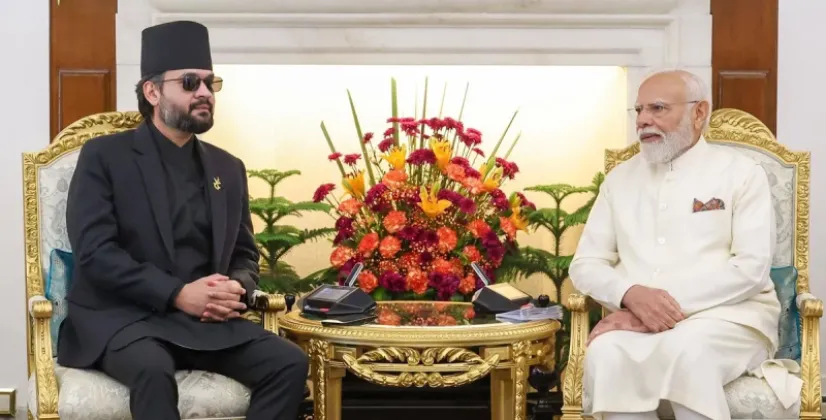
The Government of India has made it clear that the issue of Lipulekh was not raised or discussed during the recent visit of Nepal's Prime Minister Balendra Shah to New Delhi. The clarification came from India's Foreign Secretary Mishri, who addressed questions on bilateral matters following the high-level visit to the Indian capital.
In addition to ruling out any discussion on Lipulekh, Mishri also delivered a pointed message on another long-pending bilateral matter, stating that the report of the Eminent Persons Group (EPG) has lost its relevance and is now a matter of the past. The remarks were made in order to present India's official stance on key Nepal-India issues in the aftermath of the visit, which had drawn significant public and media attention in both countries.
No Discussion on Lipulekh
The Foreign Secretary's statement directly addressed speculation that the Lipulekh issue may have featured in talks between the Nepali delegation and Indian counterparts during Prime Minister Balendra Shah's stay in New Delhi. By stating plainly that there was no discussion on Lipulekh, India sought to close off narratives suggesting that the sensitive border and trade route matter had been part of the official agenda.
The clarification is significant because Lipulekh has remained one of the most closely watched subjects in Nepal-India relations. Any high-level engagement between the two neighbours is typically scrutinized in Nepal for references to the issue, and Mishri's comments appear intended to preempt misreadings of what was and was not discussed during the visit.
EPG Report Declared a Matter of the Past
Beyond Lipulekh, Foreign Secretary Mishri used the occasion to comment on the Eminent Persons Group report, saying its relevance has ended and that it now belongs to the past. The EPG was a joint mechanism formed by Nepal and India, and its report has long been a point of discussion in bilateral relations.
By declaring the report a matter of the past, the Indian Foreign Secretary effectively signaled New Delhi's position that the document should no longer be treated as a live agenda item between the two countries. The statement was made as part of India's effort to clarify its official position on bilateral matters following the high-level visit from Kathmandu.
Context of the High-Level Visit
Prime Minister Balendra Shah's visit to New Delhi was a high-level engagement between Nepal and India, and it generated considerable interest given the range of issues that traditionally define the bilateral relationship. In the days surrounding such visits, questions naturally arise in both capitals about which topics were taken up, which were avoided, and what signals each side is sending.
It was against this backdrop that Foreign Secretary Mishri offered the clarifications. The remarks served a dual purpose: first, to confirm that Lipulekh was not part of the discussions, and second, to communicate that India considers the EPG report to have lost its relevance. Together, the statements amount to a concise articulation of India's current official stance on two of the most sensitive legacy issues in Nepal-India relations.
What the Statements Signal
The clarity offered by the Indian Foreign Secretary is likely to shape how the visit is interpreted in Kathmandu and New Delhi alike. For observers in Nepal, the confirmation that Lipulekh was not discussed will be a key takeaway from the trip, while the dismissal of the EPG report as a matter of the past provides a clear indication of how India views that particular process going forward.
Mishri's comments were explicitly framed as a clarification of India's official position on bilateral matters in the wake of the visit. As reported by Ratopati and Global Aawaj, the Foreign Secretary's remarks that there was no discussion on Lipulekh and that the EPG report's relevance has ended stand as the definitive Indian characterization of what transpired during Prime Minister Balendra Shah's engagement in New Delhi.
For now, the statements from the Indian side provide the most authoritative account available of the bilateral discussions, and they leave little ambiguity: on the questions of Lipulekh and the EPG report, India has drawn a clear line regarding both what was said and what it considers settled or no longer relevant.