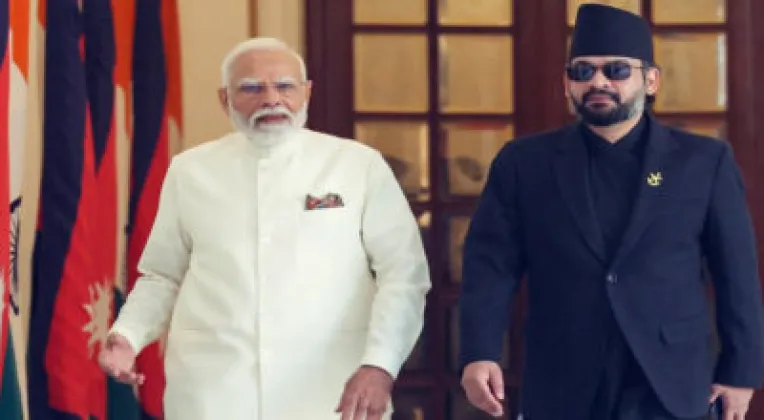
India has agreed to allow Nepal to use the Paradip port in Odisha and the Kandla port in Gujarat for its third-country import and export trade, in a decision that significantly expands the landlocked country's access to seaports in the region. The announcement was made by Indian Prime Minister Narendra Modi at a joint press conference in New Delhi on Monday, following delegation-level talks held during Nepali Prime Minister Balendra Shah's visit to India.
The announcement marks a notable development in the transit and trade relationship between the two neighbours, giving Nepali traders additional maritime gateways beyond the ports currently in use for overseas cargo.
Additional Port Access for Nepal's Third-Country Trade
Under the agreement, Nepal will be able to route its third-country imports and exports through two more Indian seaports: Paradip, located in the eastern state of Odisha on the Bay of Bengal, and Kandla, situated on the west coast in Gujarat. These ports will join the existing arrangements that allow Nepal, as a landlocked nation, to conduct its overseas trade through Indian territory.
The decision was formally announced by PM Modi at the joint press briefing held after the two sides concluded delegation-level talks. The expansion of port access is expected to provide Nepali businesses with more routing options, potentially easing congestion at existing transit points and offering flexibility depending on the origin or destination of cargo.
For Nepal, which depends heavily on Indian transit routes for trade with countries beyond its immediate neighbours, the addition of Paradip and Kandla represents a widening of the basket of ports available to its traders. The two ports, located on India's eastern and western seaboards respectively, open up new corridors for Nepali cargo moving to and from overseas markets.
Talks During PM Shah's Visit to New Delhi
The announcement came at the conclusion of Nepali Prime Minister Balendra Shah's visit to India, where the two leaders held comprehensive talks accompanied by their respective delegations. The discussions between PM Modi and PM Shah covered a range of bilateral issues, with transit and trade matters featuring prominently.
At the joint press conference held in New Delhi on Monday, PM Modi announced the decision to grant Nepal access to the two additional ports, framing it as part of the outcomes of the two leaders' discussions. The delegation-level talks that preceded the press briefing allowed officials from both sides to discuss bilateral cooperation in detail before the leaders addressed the media.
The visit and the resulting announcement underline the importance both governments attach to connectivity and trade facilitation in their bilateral relationship, with port access being a long-standing matter of interest for Nepal given its landlocked geography.
Dhamra Port Also on the Agenda
Beyond the Paradip and Kandla announcements, the two leaders' talks also covered Nepal's trade through the Dhamra port, another Odisha-based facility on India's eastern coast. The discussion of Dhamra alongside the newly announced ports indicates that Nepal is seeking to diversify its maritime transit points across multiple locations on India's seaboard.
With Paradip and Dhamra both located in Odisha, and Kandla serving India's western coast, Nepal's port access portfolio now spans a broader stretch of Indian territory. This geographic spread offers Nepali traders corridors suited to different cargo flows, whether bound for or originating from markets to the east or the west.
What the Decision Means for Nepal's Trade
As a landlocked country, Nepal's ability to engage in third-country trade depends entirely on transit agreements with its neighbours, principally India. Access to additional seaports reduces reliance on any single transit route and can help traders respond to logistical challenges such as port congestion, route disruptions, or shifting trade patterns.
The inclusion of Paradip and Kandla in Nepal's list of usable ports adds to the practical options available to Nepali importers and exporters. Traders moving goods to and from overseas markets will now have the choice of routing cargo through ports on both of India's coasts, a flexibility that has been a consistent ask in Nepal's trade diplomacy.
The announcement, delivered personally by Prime Minister Modi at the joint press conference, also carries political significance, signalling New Delhi's willingness to accommodate Nepal's requests on transit matters during this high-level visit. For Kathmandu, the outcome of PM Shah's talks in New Delhi provides a concrete deliverable on connectivity, a priority area in Nepal-India relations.
A Step in Bilateral Relations
The port access agreement was among the outcomes announced following the delegation-level talks between the two governments during the visit. While the joint press conference highlighted the transit decision, the broader discussions between PM Modi and PM Shah reflected the ongoing engagement between the two neighbours on trade and connectivity.
The decision to open Paradip and Kandla to Nepali third-country trade, along with the discussion of Dhamra port, points to a shared interest in strengthening the transit framework that underpins Nepal's overseas commerce. Further details on the operationalisation of the new port access are expected to be worked out between the relevant authorities of the two countries.
For now, the announcement stands as the headline outcome of the visit, with Nepali traders gaining two additional gateways to global markets through Indian territory.