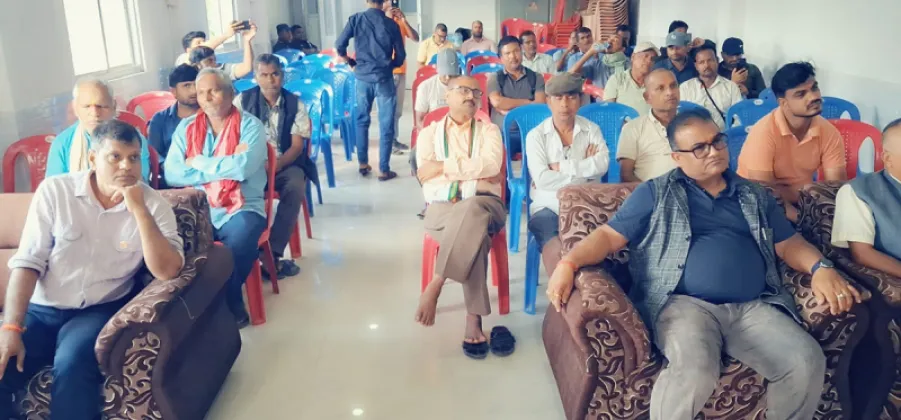
The first Saptari district convention of Hunkar Madhesh concluded on Tuesday with the formation of a 34-member district activist group under the leadership of Shaishav Raju. The gathering took place at the hall of the Saptari Chamber of Commerce and Industry, where Hunkar Madhesh central spokesperson Keshav Kumar delivered the event's principal political address, telling participants that no good party had been built in the past 75 years and that the country's parties had failed to adopt the ideas and principles needed to secure collective identity and rights. According to Nepal Press, the newly formed group will focus on expanding the organization across the district.
A new district team for Saptari
The convention, covered by Nagarik News, was the first such gathering Hunkar Madhesh has held in Saptari, and it served as the occasion to put a formal district-level structure in place. The centerpiece of the day was the constitution of the 34-member district activist group, which will now operate under Raju's leadership and carry responsibility for the organization's growth in the district.
The fact that the Saptari event was the first district convention indicates that the organization is in an early phase of building its district presence. Convening activists in a single hall, constituting a working team and hearing from a central leader are the classic steps by which a political organization turns scattered supporters into an organized unit, and the Saptari gathering followed that sequence from start to finish.
The main outcomes of the convention are as follows:
- The first Saptari district convention of Hunkar Madhesh was held on Tuesday at the hall of the Saptari Chamber of Commerce and Industry.
- A 34-member district activist group was formed through the convention.
- Shaishav Raju will lead the newly formed group.
- Central spokesperson Keshav Kumar addressed the gathering, delivering the convention's key political message.
Kumar: 75 years without a good party
The most striking intervention of the day came from Kumar, Hunkar Madhesh's central spokesperson. In his address, he said that no good party had been built in the past 75 years, a pointed critique of the political establishment offered in front of the very activists being organized to challenge it. His argument was that the parties active over this long stretch have failed to adopt the ideas and principles required to secure collective identity and rights.
The statement framed the political reasoning behind the Saptari convention itself. By characterizing seven decades of party-building as a failure, Kumar positioned Hunkar Madhesh as an organization that intends to do things differently, beginning with the kind of district-level groundwork displayed in Saptari. For the activists present, the message doubled as a rationale for the expansion work that now lies ahead of their new team.
Focus on organizational expansion
According to Nepal Press, the group formed in Saptari is focused on expanding the organization. That brief places structural growth at the center of the new team's immediate agenda: broadening the activist network, consolidating the district unit and extending the organization's reach within Saptari. The activist group designation itself underscores this emphasis, signaling a body oriented toward mobilization and fieldwork.
District conventions of this kind typically play a foundational role in a political organization's growth. They put a local leadership team in place, give cadres a visible event around which to organize and create a channel through which central leadership can communicate with the grassroots. In Saptari, the convention completed each of these steps in a single day, leaving the new 34-member team in position with a clear mandate.
Saptari, one of the eight districts of Madhesh Province, has long been part of the political landscape in which questions of identity and rights feature prominently. These are precisely the themes Kumar invoked in his address, linking the district-level organizing drive to the broader argument that existing parties have neglected the ideas and principles needed to secure collective rights.
Structure and message in one gathering
The Saptari convention brought together the two elements a growing political organization needs most: structure and message. On the structural side, the day produced a defined 34-member leadership team under Raju. On the messaging side, Kumar's critique of 75 years of party-building supplied the narrative that the new team can carry into its expansion work.
With the convention concluded, the immediate test for the new district body will be organizational: converting the momentum of a first convention into sustained growth across Saptari. For an organization whose central spokesperson argues that the country has waited 75 years for a good party, the work that begins in Saptari now carries the burden of demonstrating that a different kind of party can, in fact, be built.