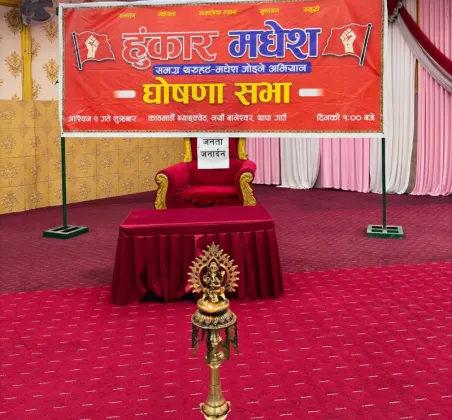
Hunkar Madhesh, a political campaign formed by leaders who broke away from various Madhes-based parties, has announced a three-phase Hulaki Yatra beginning on December 1, corresponding to Mangsir 10 of the current fiscal year. The announcement marks the campaign's first major public mobilisation since its formation, signalling its intent to take its message directly to communities across the Tarai-Madhesh region.
Campaign coordinator Ram Kumar Sharma confirmed the launch plan, stating that the journey will proceed in three distinct phases. Ahead of the yatra's commencement, the campaign intends to submit a formal memorandum to Prime Minister Balendra Shah, scheduled for a day before the journey begins, that is, on November 30.
Why the campaign was formed
According to the campaign, Hunkar Madhesh was launched with a clear plan to bring change to Madhes. Its founders argue that the older Madhes-based parties have failed to address the aspirations of the people of the region, particularly on the question of generational transition in party leadership.
The leaders behind the campaign, having split from a range of established Madhes-based parties, position themselves as an alternative force. They contend that the old parties' inability to hand over leadership to a newer generation has stalled the political and social progress of Madhes, and that a fresh movement is needed to articulate the demands of ordinary Madhesi citizens.
A journey with postal significance
The decision to name the mobilisation a Hulaki Yatra carries symbolic weight. Hulaki, the traditional postal system, historically connected villages and towns across the Tarai long before modern communication networks existed. By invoking the hulaki, the campaign aims to link its journey with a heritage of communication and connection that runs deep in Madhesi history.
The three-phase structure of the yatra suggests the organisers plan to reach different parts of the region over successive legs of the journey, though the detailed itinerary of each phase has not yet been laid out publicly. The campaign has framed the yatra as a listening and outreach exercise, taking its message of change to the people rather than confining its politics to Kathmandu's corridors of power.
Memorandum to the Prime Minister
The planned memorandum to Prime Minister Balendra Shah underscores the campaign's intention to place its concerns before the federal government at the very outset of its mobilisation. By submitting the memorandum a day before the yatra begins, the campaign seeks to ensure that its demands are formally registered with the highest office in the government as the journey gets underway.
Sharma's announcement positions the memorandum as a formal declaration of the campaign's grievances and objectives, setting the stage for the phases of the yatra to follow. The campaign hopes that this combination of formal petition and grassroots travel will build momentum for its broader agenda of transforming Madhes.
A new force in Madhes politics
The emergence of Hunkar Madhesh adds a new dimension to the political landscape of the Tarai, which has for years been dominated by a handful of established Madhes-based parties. The leaders who have joined the campaign argue that fragmentation, ageing leadership and repeated failures to deliver meaningful change have eroded public trust in those parties.
By launching the Hulaki Yatra, the campaign is betting that direct contact with voters, framed around the language of generational change, can carve out political space for a new alternative. The success of the three-phase journey, beginning December 1 with a memorandum to the Prime Minister, will be an early test of whether the campaign can convert the discontent it says it represents into a durable political movement across Madhes.