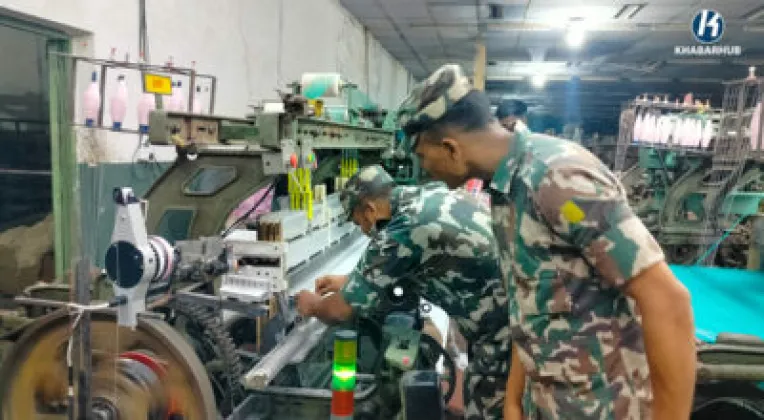
The Hetauda Textile Industry, which remained shut for 26 years, has finally roared back to life, at least in a limited way, as the government began trial production at the historic industrial unit starting last Shrawan. Under the initial phase, 15 of the industry's 408 looms have been repaired and put into operation, with the technical management of the production process entrusted to the Nepali Army.
The restart marks a significant moment for Makwanpur district and for Nepal's broader efforts to revive the state-owned industries that once anchored the country's manufacturing sector. For decades, the sprawling industrial complex in Hetauda stood idle, its machines silent and its workforce dispersed, a lingering reminder of the decline of Nepal's public-sector enterprises. Now, the sound of operating looms has returned to the factory floor, albeit on a modest scale.
What Is Being Produced
The machines currently in operation are producing uniforms for female civil servants as well as bedsheets for hospitals. This initial product line gives the revived industry an immediate and practical purpose: supplying government institutions with fabric items they regularly need.
By directing early production toward public-sector demand, the government appears to be giving the industry a guaranteed market during its trial phase. Uniforms for civil servants and hospital bedsheets are recurring requirements of state institutions, and using the Hetauda Textile Industry to meet that demand allows the trial run to demonstrate tangible output without depending entirely on competitive market sales.
The choice of products also highlights the government's intent to show visible results quickly. Rather than waiting for full-scale restoration of all 408 looms, authorities have opted to start with a small, functional segment of the factory that can deliver usable goods while broader plans are worked out.
The Nepali Army's Technical Role
A distinctive feature of the revival effort is the role assigned to the Nepali Army, which has been given responsibility for the technical management of production. The involvement of the army in managing the technical side of a civilian industrial unit is an unusual arrangement, and it reflects the government's reliance on the institution's organizational capacity to run the factory's day-to-day operations during this delicate trial period.
Under this arrangement, the army oversees the operation of the repaired looms and the production process itself. The move suggests that the government wants disciplined, technically supervised management at the outset, possibly to ensure that the trial phase proceeds smoothly and that the machinery, much of which has sat unused for over a quarter century, is handled with care.
The 15 looms now running represent only a small fraction of the industry's total capacity of 408 looms. Bringing the full complement of machines back into service would require far more extensive repairs, and the current trial production phase is expected to inform decisions about how quickly and extensively to expand operations.
A Closure Spanning 26 Years
The Hetauda Textile Industry's closure dates back 26 years, a period during which the factory became one of the most prominent symbols of Nepal's struggling public enterprises. Once part of the country's network of government-run industries established to drive domestic manufacturing, the textile factory eventually ceased operations, leaving its buildings and machinery to deteriorate.
The industry's decline mirrored broader challenges faced by state-owned manufacturing units in Nepal, including outdated technology, financial losses and management difficulties. Over the years, successive governments have periodically discussed reviving the Hetauda Textile Industry, but concrete progress remained elusive until the current effort, which moved from planning to actual trial production beginning last Shrawan.
For the local economy of Hetauda, the reopening carries particular weight. The industry was historically a major employer in the area, and its revival, even in a limited trial form, has raised hopes that jobs and industrial activity could return to the town.
Support From the Chinese Government
The effort to restart the industry has also drawn on international support, with the Chinese government extending assistance to the revival process. This cooperation forms part of the broader backdrop to the current trial production, which has combined domestic institutional involvement, through the Nepali Army's technical management, with foreign support for the restoration of the factory.
The Chinese assistance underscores the diplomatic and economic dimension of the project. China has been involved in various infrastructure and industrial cooperation efforts in Nepal, and its support for the Hetauda Textile Industry adds an external pillar to what is otherwise a domestically driven initiative.
The Road Ahead
While the start of trial production is being welcomed as a milestone, it is only a first step. Fifteen looms out of 408 represent a fraction of the industry's potential capacity, and the road to full-scale operation will require substantial investment in repairing and restoring the remaining machinery, as well as decisions about staffing, product lines and market strategy.
The current production of civil servant uniforms and hospital bedsheets provides the trial phase with a clear, measurable output. How successfully the army-managed operation sustains and scales up production in the coming months will likely shape the government's next decisions about the industry's future.
For now, after 26 years of silence, the Hetauda Textile Industry is once again weaving fabric, and the government, the Nepali Army and the local community will be watching closely to see whether this trial run can grow into a durable industrial revival.