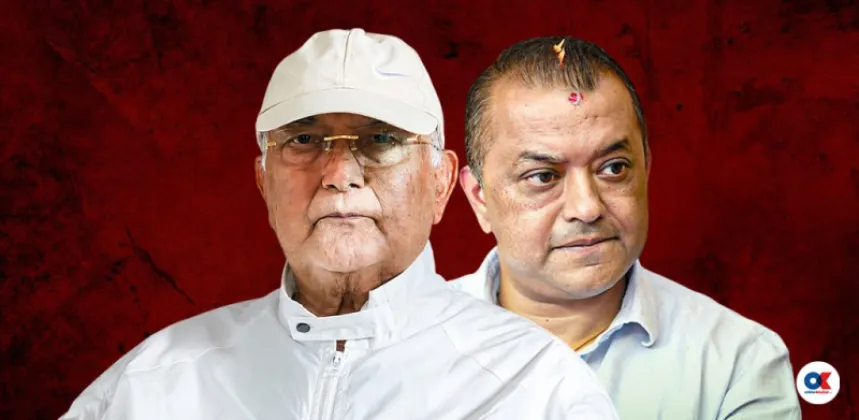
Nepali Congress President Gagan Thapa met CPN-UML Chairman KP Sharma Oli at the latter's residence on Tuesday evening, in the first high-level encounter between the two leaders since last year's Gen Z movement. The meeting, which lasted for around an hour, comes at a politically charged moment for Nepal, arriving amid escalating tensions between Prime Minister Balendra Shah and Thapa.
First high-level contact since the Gen Z movement
The hour-long conversation marked the first time Thapa and Oli had come face to face at a high level since the Gen Z movement swept across the country last year and redrew the contours of Nepal's political order. In the period since that upheaval, direct contact between the leaderships of the Nepali Congress and the CPN-UML, the two forces that have dominated Nepal's political landscape for decades, has been rare, which is why Tuesday's meeting is being seen as significant.
Thapa, who leads the Nepali Congress, called on Oli at his residence, according to reports in Online Khabar and Ratopati. The venue itself carried weight. A one-on-one sit-down at the private residence of the CPN-UML chairman, rather than a formal party office or a public event, suggested the two leaders wanted a private and direct conversation.
According to a source close to Thapa, the meeting lasted for around an hour, long enough to move beyond pleasantries and into substantive political discussion.
The meeting at a glance
- Who: Nepali Congress President Gagan Thapa and CPN-UML Chairman KP Sharma Oli
- Where: Oli's residence
- When: Tuesday evening, for around an hour
- Why it matters: It was the first high-level encounter between the two leaders since last year's Gen Z movement
- What was discussed: The Madhesh provincial government and other political issues, according to a source close to Thapa
Madhesh provincial government tops the agenda
The most concrete detail to emerge from the meeting concerns its subject matter. A source close to Thapa said the two leaders discussed the Madhesh provincial government, along with a range of other political issues.
While the source did not spell out what was said about the province, the topic is a consequential one. The Madhesh provincial government is one of the key pieces of Nepal's federal structure, and its fate has often depended on the equations struck by the national parties. Any conversation between the president of the Nepali Congress and the chairman of the CPN-UML that touches on the province's government will inevitably be watched closely in political circles in the province and beyond.
No details were immediately available on whether the conversation produced any understanding between the two parties on the province, or on any of the other issues raised. What is clear is that the discussion was political in nature rather than ceremonial, and that the Madhesh provincial government featured prominently enough within it to be singled out by the source briefed on the meeting.
A meeting timed against a backdrop of tensions
The political significance of the meeting is heightened by its timing. According to the reports, it comes amid escalating political tensions between Prime Minister Balendra Shah and Thapa.
That context turns what might otherwise have been a routine call on a senior leader into a closely watched political event. The Nepali Congress president's decision to meet Oli, the chairman of a party with which the Congress has alternated between rivalry and coalition over the years, sends a signal that will be parsed in every quarter of the country's political establishment, particularly at a moment when relations between the Prime Minister and Thapa themselves are strained.
The source close to Thapa did not indicate whether the tensions with the Prime Minister figured in the conversation between the two leaders. Nor was it clear whether Tuesday's meeting might lead to further contacts between the Nepali Congress and the CPN-UML at the leadership level in the days ahead.
Where things stand
For now, the confirmed facts are limited but telling. Two of the most prominent figures in Nepali politics, the president of the Nepali Congress and the chairman of the CPN-UML, have held their first substantial high-level meeting since last year's Gen Z movement, and they have done so at a moment when the country's political fault lines, from the tensions surrounding the Prime Minister to the question of the Madhesh provincial government, are unusually active.
The meeting also underscores how, months after the Gen Z movement reshaped the country's politics, its established players are once again engaging directly with one another at the top. Whether the hour at Oli's residence proves to be an isolated exchange or the beginning of a broader political recalibration will become clear only in the days ahead. What is already evident is that the channel of communication between Nepal's two major parties at the leadership level, quiet since the Gen Z movement, is open again.