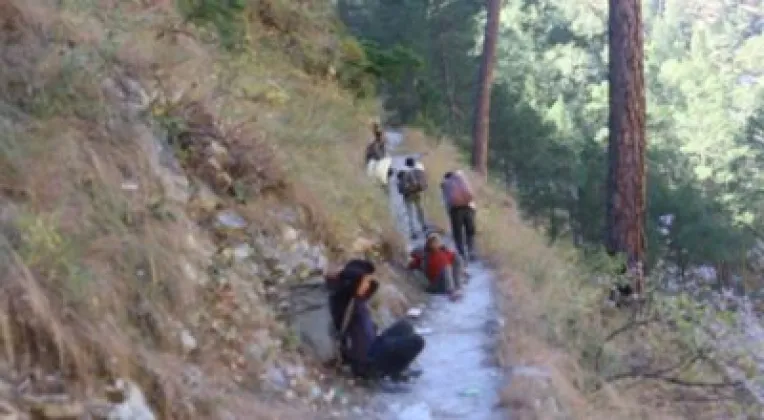
Four wards in Bajura district remain without any road connection, according to reports published on 7 Kartik, underscoring how unevenly road infrastructure has expanded across the remote hill district of far-western Nepal. Although road expansion is widely regarded as a key basis for development, residents of these settlements continue to live outside the road network, and that absence shapes nearly every part of their daily lives, from how household goods reach them to how patients are carried to care and how farm produce is taken to market.
Four Wards Still Beyond the Network
Reports carried by Khabarhub and Rajdhani Daily highlight that, even as road infrastructure is treated as a central measure of progress, four wards of Bajura district are still deprived of road facilities. The reports describe a district where road expansion is regarded as a key basis for development, yet where residents of some settlements, grouped within these four wards, remain beyond the reach of any vehicle track. For the people living there, daily routine differs sharply from life in connected areas, where goods, services and people move by road.
The distinction matters because of what roads make possible. Where a road reaches a settlement, supplies can be transported in, patients can be driven out, and harvests can be carried to buyers. Where it does not, each of those movements depends entirely on human effort. The reports make clear that residents of the unconnected wards remain deprived of road facilities, and that this deprivation has spread into nearly every dimension of their livelihood.
The Daily Burden of Inaccessibility
According to the reports, the lack of road access is not a single hardship but a cluster of them, felt at each stage of rural life. Locals face particular difficulty in three main areas:
- Everyday supplies: Transporting daily consumer goods to the settlements is difficult without a road, turning routine household provisioning into a laborious task.
- Health emergencies: Taking patients to health facilities is a struggle when no vehicle can come near the village, leaving the sick and injured dependent on slow, manual transport.
- Farm incomes: Bringing agricultural produce to market is equally difficult, cutting farmers off from the buyers their harvests are meant to reach.
The reports state plainly that the lack of roads has affected residents' daily livelihood, and the mechanics of that impact are straightforward. A farm that cannot move its produce to market loses much of its commercial value. A household that must spend time and effort hauling consumer goods has less left for other work. A family facing a medical emergency must treat the journey itself as part of the risk. In connected areas, these movements are taken for granted; in the four unconnected wards of Bajura, each one becomes a project of its own.
Roads as the Backbone of Development
The reports frame road infrastructure expansion as a key basis for development, a view that reflects how central connectivity has become to measuring progress. Roads are the physical link between villages and the services that surround them: health facilities, markets, and the supply chains that keep consumer goods moving. When that link is missing, development that depends on movement, whether of goods, patients or produce, cannot function as it should.
Bajura's four unconnected wards illustrate the gap between the principle and the practice. A district that regards roads as a foundation of development still contains settlements where that foundation has yet to be laid. The reports, published on 7 Kartik, present the situation not as a temporary inconvenience but as a standing condition, one that continues to define how residents supply their homes, seek treatment and earn their living.
Living With the Gap
For now, residents of the four wards continue to manage without the facility that their connected neighbours take for granted. The difficulties documented in the reports, getting consumer goods in, getting patients to health facilities, and getting agricultural produce out to market, offer a concrete measure of what connectivity means in rural Nepal, by showing what daily life looks like without it.
What the reporting from Khabarhub and Rajdhani Daily records is a simple but consequential fact: in Bajura, the expansion of road infrastructure, regarded as a key basis for development, has not yet reached every ward. Four of them remain outside the network, and their residents remain deprived of road facilities. Until that changes, the burden of moving goods, people and produce will continue to fall on the residents themselves, and the livelihoods of these settlements will continue to bear the cost of the missing road.