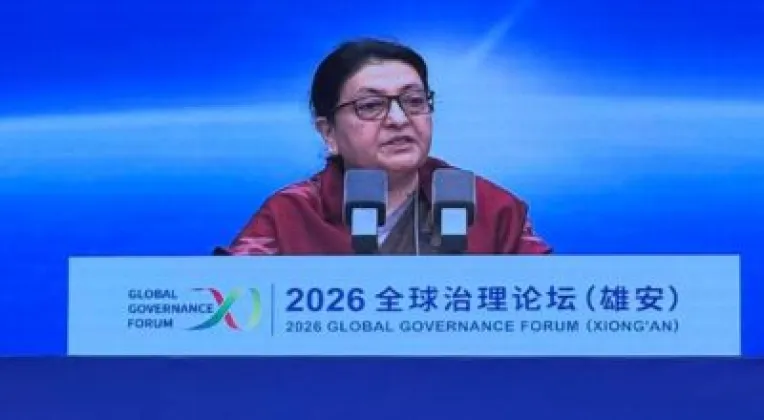
Former President and senior CPN-UML leader Bidya Devi Bhandari has urged the international community to take Nepal's demand for climate justice seriously, warning that recent devastating natural disasters have exposed the country's acute vulnerability to climate change. Bhandari delivered the message at the 2026 Global Governance Forum (Xiong'an), organised by the China Institute of International Studies in China, where she also called for fair global governance and the equal participation of all countries in international decision-making. Her address, reported by Kathmandu-based outlets on October 24, 2026, placed Nepal's climate concerns before a prominent international audience.
A Plea for Climate Justice
At the heart of Bhandari's intervention was a direct appeal on behalf of Nepal. Addressing delegates at the forum, she said the international community must treat the country's demand for climate justice with the seriousness it deserves, arguing that the recent spate of devastating natural disasters has demonstrated just how exposed Nepal is to the consequences of a changing climate.
Nepal's Vulnerability in Focus
Nepal's mountainous terrain and fragile Himalayan ecosystem place it among the geographies most exposed to climate stresses, and the disasters Bhandari referenced have underlined the human and economic stakes for its people. Her argument to the forum was straightforward: countries in Nepal's position, which carry heavy climate burdens, cannot be left to cope alone, and a just global response must recognise the imbalance between those who suffer the worst impacts and the wider world that shapes their fate.
The demand for climate justice, as raised by Bhandari, centres on the idea that nations enduring the sharpest consequences of global warming deserve fair recognition and meaningful support from the international community. By voicing that demand at a global forum, she sought to connect Nepal's recent hardships to a larger conversation about responsibility and equity in international affairs.
Fair Global Governance and Equal Participation
Beyond climate, Bhandari used the platform to press the case for a reformed and fairer system of global governance. She called for the equal participation of all countries, a message aimed at ensuring that smaller and developing nations enjoy the same voice as major powers in shaping the rules and institutions that govern international affairs.
The 2026 Global Governance Forum (Xiong'an) offered a fitting stage for that argument. Organised by the China Institute of International Studies, the forum serves as a platform for deliberation on how global affairs are managed at a time of mounting shared challenges. Bhandari's contribution placed the concerns of climate-vulnerable, developing countries squarely within that conversation.
Her key messages, as reflected in her address and its coverage, can be summarised as follows:
- A call for fair global governance built on the equal participation of all countries
- An appeal for the international community to take Nepal's demand for climate justice seriously
- A warning that recent devastating natural disasters have exposed Nepal's vulnerability to climate change
- An emphasis on resolving disputes through dialogue and diplomacy, not weapons
Dialogue and Diplomacy, Not Weapons
The full text of her address, published by Ratopati, shows that Bhandari extended her argument on fair governance to the question of international peace. Disputes between countries, she said, should be resolved through dialogue and diplomacy rather than weapons.
That position sits naturally alongside her wider theme. In her framing, the way states manage their differences is inseparable from the way they confront shared threats such as climate change: both demand cooperation, negotiation and sustained engagement rather than confrontation. Delivered at a forum devoted to the question of global governance, the remarks reinforced the case that a stable international order rests on conversation and consensus, not force.
A Prominent Nepali Voice on the Global Stage
Bhandari's appearance at the Xiong'an forum underlines her continued engagement in international diplomacy as a former head of state, and it adds a prominent Nepali voice to growing global debates over climate equity and the fairness of the international system.
For Nepal, the significance is twofold. Her remarks elevated the country's demand for climate justice before an international audience at a time when recent disasters have made the stakes vividly clear at home. At the same time, her call for equal participation speaks to a long-held aspiration of smaller nations: a genuine seat at the table when the rules of the international order are written and applied.
Whether such deliberations translate into concrete support for climate-vulnerable countries like Nepal remains to be seen. What is clear is that Bhandari used her platform to insist that climate justice is not a rhetorical flourish but a pressing necessity, and that the international community's response will say much about how fair, and how equal, global governance truly is.