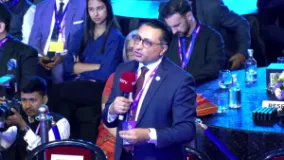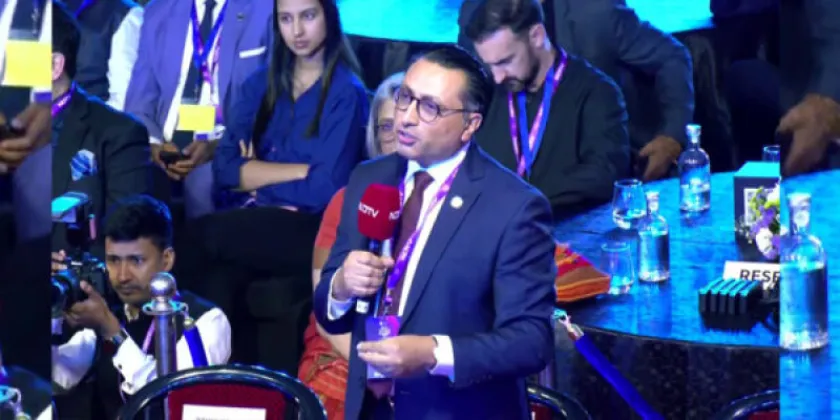
Finance Minister Dr. Swarnim Wagle has declared that the era of defining Nepali nationalism through opposition to India is over, arguing instead that the country's future rests on economic prosperity and good governance delivered through a friendly and forward-looking relationship with its southern neighbour. Speaking at the NDTV World Summit 2026 in New Delhi, Dr. Wagle said that while problems occasionally arise in Nepal-India relations, these should be seen as opportunities for mutual economic gain rather than through the lens of opposition and distrust, according to reports carried by Himal Press and Global Aawaj.
Redefining Nationalism for a New Era
The Finance Minister's central message was a direct challenge to a long-standing framing of Nepali nationalism that has often equated patriotic credentials with distance from, or criticism of, India. Speaking from one of the most prominent international platforms in the Indian capital, Dr. Wagle made clear that he believes that mindset belongs to the past. In his assessment, the days when political leaders and commentators measured their nationalist commitment by how firmly they stood against India are gone.
His remarks carry weight given the position he holds and the stage on which they were delivered. Addressing an audience at the NDTV World Summit 2026 in New Delhi, the Finance Minister was speaking directly to Indian policymakers, business leaders and international observers, at a moment when Nepal's economic agenda and its diplomatic posture are under close scrutiny. Rather than hedging on a sensitive subject, he chose to state plainly that the old arithmetic of nationalism, in which opposition to India counted as loyalty to Nepal, no longer reflects the aspirations of the country or its people.
Problems as Opportunities, Not Distrust
Dr. Wagle acknowledged that Nepal-India relations are not free of friction. Problems between the two countries, he said, do arise from time to time, as is common between close neighbours with deep and complex ties. What matters, he argued, is how those problems are framed and addressed. In his view, each such issue should be treated as an opportunity for economic prosperity, for both countries, rather than being allowed to feed a cycle of opposition and mutual distrust.
This framing represents a distinctly economic approach to diplomacy. By positioning bilateral challenges as openings for cooperation, investment and shared growth, the Finance Minister signalled that Nepal's engagement with India under the current direction of policy is intended to be constructive and prosperity-focused. The message to the summit audience was that disagreements, when they occur, need not define the relationship, and that the larger project of lifting living standards in Nepal gives both sides a reason to work through them.
The Aspirations of a New Generation
A key thread of Dr. Wagle's address was generational. The aspirations of Nepal's new generation, he said, centre on two things: economic prosperity and good governance. For young Nepalis, in his telling, the political debates and nationalist posturing of earlier decades are not what drive their ambitions. They are looking for jobs, opportunity, accountable institutions and a state that delivers.
This reading of the national mood carries significant implications for how Nepal conducts its foreign policy. If the priorities of the emerging generation are prosperity and governance, then the country's external relationships, including the one with India, will be judged by how effectively they serve those goals. Dr. Wagle's remarks suggested that Nepal's leadership is increasingly responsive to that shift, treating economic delivery at home as inseparable from the quality of its relationships abroad.
Foreign Policy Moving in a Positive Direction
The Finance Minister also offered a confident assessment of the trajectory of Nepal's foreign policy, saying it is moving in a positive direction. Coming from the minister responsible for steering the country's economy, the statement was an endorsement of the current course of Nepal's external engagement and a signal of continuity to regional and international partners.
Speaking in New Delhi gave that reassurance particular resonance. India remains Nepal's most consequential bilateral partner, and public comments by a sitting Nepali Finance Minister on Indian soil about the end of opposition-based nationalism will be read in both capitals as a statement of intent. By coupling his generational argument with a positive verdict on foreign policy, Dr. Wagle presented a coherent picture: a Nepal that seeks prosperity and good governance for its people, approaches its neighbours with confidence rather than suspicion, and views the occasional problems in its relations with India not as grounds for confrontation but as opportunities to build shared economic gains.
For observers of Nepal-India relations, the address at the NDTV World Summit 2026 offered a clear articulation of how Kathmandu's current leadership wishes the relationship to be understood: forward-looking, economically anchored and free of the old reflex to measure patriotism by antagonism toward a neighbour.