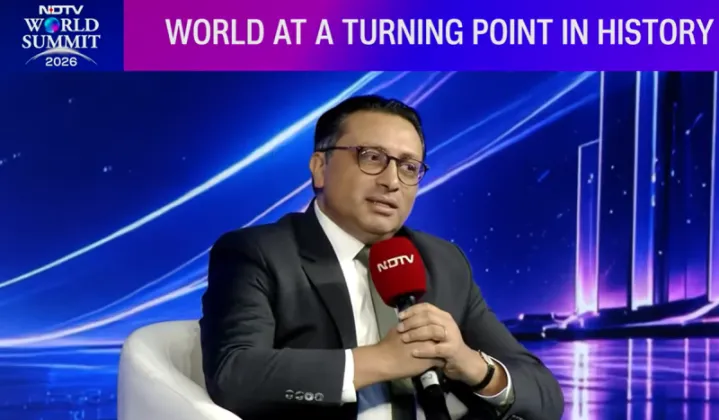
Finance Minister Swarnim Wagle has declared that the era of anti-India nationalism in Nepal has come to an end, a statement that speaks directly to the country's economic and foreign affairs posture toward its southern neighbour. The remarks were reported on October 23, 2026, by Nepali news outlets Nepal Lead and Baahrakhari, and they arrive at a moment when Kathmandu's approach to India remains one of the most closely followed questions in the country's public life. Coming from the finance minister, whose portfolio sits at the intersection of Nepal's economic management and its external economic relationships, the declaration carries a weight that ordinary political rhetoric about Nepal-India ties rarely does.
The Remark, as Reported
According to Nepal Lead and Baahrakhari, Swarnim Wagle stated plainly that the era of anti-India nationalism in Nepal has ended. The coverage, published on October 23, 2026, centres on that core declaration and on what it suggests about the direction of Nepal's official stance toward India. Both outlets frame the statement as touching on Nepal's economic policy as well as its foreign affairs, placing the remark squarely within the ongoing conversation about how Nepal positions itself beside its largest neighbour.
The phrasing of the statement is significant in itself. By declaring that the anti-India nationalism era is over, the finance minister is effectively arguing that Nepal's politics and policy should no longer be organised around opposition to India. In Wagle's telling, as reflected in the reporting, that current has run its course, and the country's posture toward India can now be considered on other terms.
An Economic Portfolio with Diplomatic Reach
Part of what makes the remark notable is the office from which it was made. As finance minister, Wagle leads the institution through which Nepal's budget, expenditure priorities and economic policy flow. When the finance minister speaks about nationalism directed at India, the comment inevitably connects to the economic dimension of the bilateral relationship, the area where the two countries' interests are most directly entangled.
The reporting indicates that the statement touches on two intertwined dimensions of Nepal's posture toward India:
- Economic posture: how Nepal positions itself on matters of trade, investment and cross-border economic cooperation, areas that fall within the finance ministry's day-to-day remit and that shape the material terms of the Nepal-India relationship.
- Foreign affairs posture: the tone and orientation of Nepal's diplomacy toward India, including whether political rhetoric rooted in anti-India sentiment continues to influence the country's external stance.
Read together, the two dimensions suggest that Wagle's declaration is not merely a comment on public mood. It is a statement about how a senior economic official in Nepal's government believes the country should approach a relationship that is simultaneously political, diplomatic and economic. That framing is consistent with the summaries carried by Nepal Lead and Baahrakhari, which present the remark as touching on both the economic and the foreign affairs side of Nepal's dealings with India.
What the Declaration Signals
At its most basic level, the statement is a claim about Nepal's political moment: that sentiment organised around opposition to India no longer defines the era, in the finance minister's assessment. Wagle's remark, as reported, asserts a turning of the page rather than a continuation of familiar political dynamics, and it does so from a position of authority within the government.
For readers tracking Nepal-India relations, the significance lies in the messenger as much as the message. Statements about India from Nepal's political leadership are routinely scrutinised for what they reveal about official thinking. A declaration from the finance minister that the anti-India nationalism era is over will therefore be read as an articulation of the government's broader orientation, particularly on the economic front, where the ministry Wagle leads has the most direct leverage.
The statement also invites attention to what follows. If, as Wagle suggests, the era of anti-India nationalism has ended, the practical question becomes what replaces it in Nepal's economic and diplomatic posture toward India. The reported remarks gesture in that direction by tying the declaration to Nepal's economic and foreign affairs stance, but the substantive policy details remain to be seen in the available coverage.
Coverage, Context and What Remains Unknown
The remarks were carried by two Nepali outlets, Nepal Lead and Baahrakhari, on October 23, 2026. The reporting available at this stage centres on the core declaration itself, along with its connection to Nepal's economic and foreign affairs posture toward India. Details such as the specific occasion on which Wagle made the remark, the full transcript of his comments and any subsequent reaction from other political figures or from India have not been included in the material published so far. Readers can follow the original report at Nepal Lead.
Those gaps matter for anyone assessing the statement's full implications. A declaration of this kind can carry different weight depending on whether it was made at a policy forum, in parliament, at a party gathering or in remarks to the press, and the surrounding context typically shapes how governments and markets respond. Follow-up reporting from Nepal Lead, Baahrakhari and other outlets is likely to fill in that picture.
For now, the statement stands on its own as a clear articulation from Finance Minister Swarnim Wagle that, in his assessment, the era of anti-India nationalism in Nepal is over. Given the finance ministry's central role in shaping Nepal's economic direction, and given the sensitivity with which statements about India are read in Kathmandu and beyond, the remark is expected to draw continued attention as Nepal's economic and foreign policy posture toward India evolves.