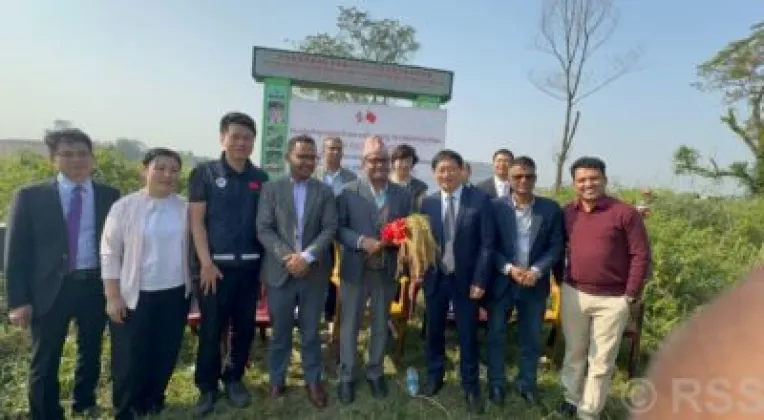
A hybrid rice demonstration project supported by Chongqing, China, has recorded an average yield of 6.86 tonnes per hectare at the Nepal Southern Agricultural Science and Technology Park in Chitwan, Nepal. The results were confirmed during a harvesting ceremony held on November 25, which brought together rice experts from Chongqing and researchers from the Agriculture and Forestry University (AFU) of Nepal.
The trial was conducted with technical support from the Chongqing Academy of Agricultural Sciences in collaboration with Nepali agricultural experts, marking another step in the growing agricultural cooperation between the Chinese municipality and Nepal's farming research community.
A Harvest Ceremony to Mark the Results
The harvesting ceremony, held on November 25 at the Nepal Southern Agricultural Science and Technology Park in Chitwan, served as the formal occasion for measuring and announcing the yield of the hybrid rice demonstration plot. Rice experts from Chongqing travelled to Nepal to join their counterparts from the Agriculture and Forestry University for the event.
Harvest ceremonies of this kind are a common practice in agricultural demonstration projects, allowing visiting experts, local researchers and university staff to jointly witness the cutting, weighing and measurement of the crop on site. This ensures that the reported yield figures are transparent and mutually verified by both sides of the collaboration.
The recorded yield of 6.86 tonnes per hectare provides a measurable benchmark for the performance of the hybrid rice varieties under Nepali growing conditions in Chitwan, a district in the southern plains of Nepal that is widely regarded as one of the country's most important agricultural zones.
Technical Collaboration Between Chongqing and Nepali Experts
The demonstration project was implemented with technical support from the Chongqing Academy of Agricultural Sciences, working in collaboration with Nepali agricultural experts. The partnership forms part of broader agricultural science and technology cooperation between Chongqing and Nepal.
The Nepal Southern Agricultural Science and Technology Park in Chitwan served as the venue for the trial, providing the infrastructure and field conditions necessary to test hybrid rice varieties under local conditions. The involvement of AFU connected the project with Nepal's academic and research community in agriculture and forestry.
Such demonstration projects typically aim to assess how externally developed hybrid varieties perform in local soil, climate and water conditions, and to give Nepali researchers direct experience with the cultivation techniques associated with them. The participation of experts from both Chongqing and AFU throughout the trial cycle, culminating in the joint harvest ceremony, reflects the collaborative character of the initiative.
Context: Hybrid Rice and Agricultural Cooperation
Rice is the staple food of Nepal, and yields in the country have long been a focus of agricultural research and development efforts. Hybrid rice varieties, which can deliver substantially higher output per hectare than traditional varieties when grown under appropriate conditions, have been a central element of China's agricultural technology engagements in South Asia and other regions.
Chitwan, located in Nepal's southern Terai plains, is among the country's leading rice-producing districts, making it a natural site for demonstration trials of improved rice varieties. The Nepal Southern Agricultural Science and Technology Park, where the trial took place, has functioned as a platform for agricultural research activities in the district.
The Chongqing Academy of Agricultural Sciences is a research institution based in Chongqing municipality in southwestern China. Its support for the Chitwan trial adds to a series of agricultural cooperation activities between Chinese institutions and Nepal in recent years, in which hybrid rice, alongside other crops and technologies, has featured prominently.
What the Result Means
The verified yield of 6.86 tonnes per hectare from the demonstration plot offers Nepali researchers and farmers a concrete data point on the productivity of the Chongqing-supported hybrid rice under local conditions. Whether such yields can be replicated at scale across Nepali farms will depend on follow-up trials, seed availability and the adaptation of cultivation practices by local farmers.
For now, the November 25 harvest ceremony in Chitwan stands as the latest tangible outcome of the partnership between the Chongqing Academy of Agricultural Sciences and Nepal's agricultural research community, with both sides present to witness the results of their joint work in the fields of the Nepal Southern Agricultural Science and Technology Park.