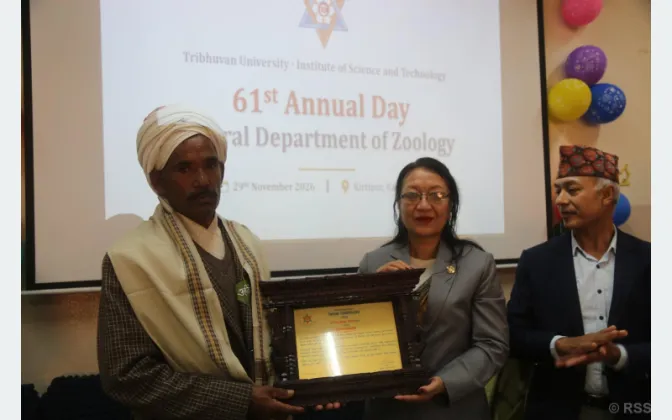
Birkha Bahadur Rokaya of Murma, Chhayanath Rara Municipality-9 in Mugu district, has been honoured by the Central Department of Zoology at Tribhuvan University in recognition of his long-standing contribution to biodiversity and wildlife conservation in the Rara area.
At a ceremony held by the department, Rokaya was presented with a certificate of appreciation and a shawl, marking the formal acknowledgement of years of grassroots conservation work in one of Nepal's most ecologically significant high-altitude regions.
Recognition for Grassroots Conservation
The honour reflects Rokaya's sustained efforts in the protection of Rara National Park, home to the largest lake in Nepal and a rich diversity of flora and fauna. Working from his home village of Murma, which lies close to the park's boundary, Rokaya has been associated with conservation initiatives that link the protection of wildlife with the wellbeing of the communities living around the protected area.
According to information shared at the event, the department recognised Rokaya not only for his work in biodiversity and wildlife conservation but also for his broader contribution to the region. His efforts in supporting local community livelihoods, raising public awareness about conservation, and contributing to rural development were all cited as grounds for the honour.
This integrated approach, which treats conservation and community development as connected goals, has become an increasingly important model in Nepal's protected areas, where local participation is often decisive in the success of conservation programmes.
The Significance of Rara
Rara National Park, located in the mid-western hills of Nepal spanning Mugu and Jumla districts, protects Rara Lake, the country's largest lake, along with surrounding coniferous forests and alpine meadows. The park is home to species such as the red panda, Himalayan black bear, musk deer and a range of birdlife, making its conservation a matter of national ecological importance.
For communities like Murma, which sit along the park's edge, conservation work requires balancing the protection of these habitats with the daily needs of people who depend on the land and forest resources. Local conservationists like Rokaya play a crucial role in this balance, acting as a bridge between park authorities and residents.
Acknowledging Local Stewards
The decision by the Central Department of Zoology, the country's leading academic institution for zoological study and research, to honour a community-level conservationist has drawn attention to the role of local stewards in Nepal's conservation landscape. While national parks and protected areas are formally managed by government agencies, decades of experience have shown that conservation outcomes in Nepal often depend on the engagement of people living in and around those areas.
Rokaya's recognition is expected to encourage other community members in Mugu and beyond to remain engaged in protecting the region's natural heritage. As pressures on Nepal's mountain ecosystems continue to grow, honours such as this one highlight the value of sustained, locally rooted conservation work, and the institutions willing to recognise it.