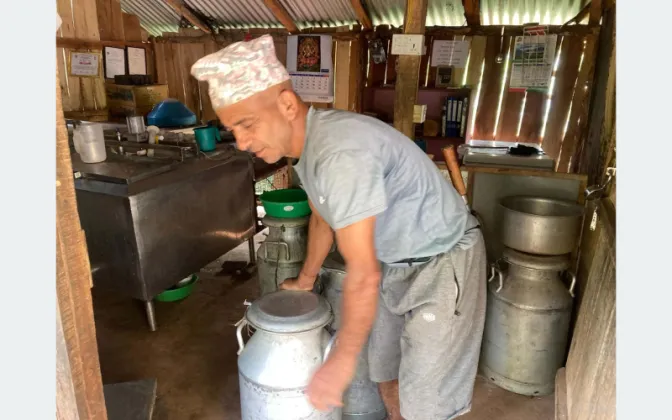
Farmers in Jaimini Municipality of Baglung district have found renewed encouragement after milk produced in their locality began being marketed through a cooperative and sold outside the district. The Jaimini Dugdha Utpadak Sahakari Sanstha has started collecting milk from local farmers and supplying it to a dairy industry in Pokhara, opening up a steady market for producers who previously struggled with limited local demand.
According to reports, the cooperative collects about 230 litres of milk daily from 35 farmers of the municipality. The milk is gathered at the cooperative and then transported to Pokhara, where it is purchased by a dairy industry, giving farmers a reliable outlet for their produce.
A Solution to Weak Local Demand
The main challenge facing dairy farmers in Jaimini has been the low level of local milk consumption. With households in the municipality unable to absorb the quantity of milk being produced, farmers had limited options for selling their surplus. This often left them discouraged and uncertain about the viability of dairy farming as an income source.
The cooperative model has addressed this problem directly. By pooling milk from its member farmers, the Jaimini Dugdha Utpadak Sahakari Sanstha is able to gather sufficient volume to make regular supply to the Pokhara market feasible. Farmers no longer need to search individually for buyers, as the cooperative handles collection and marketing on their behalf.
Farmers Drawn Back to Dairy Farming
The assured market created through the cooperative has lifted the morale of farmers in the area. With a fixed channel through which their milk is sold daily, producers say they feel encouraged to continue and even expand their dairy activities. Regular sales through the cooperative mean that milk that would otherwise have gone unsold is now converted into income for farming households.
The involvement of 35 farmers in the collection network shows that the initiative has already gained a meaningful base of participation in the municipality. Each of these farmers contributes to the roughly 230 litres collected every day, and the cooperative's role as an intermediary has given them collective bargaining strength they lacked individually.
Cooperative Marketing as a Model
The experience in Jaimini highlights the role cooperatives can play in connecting rural producers with urban markets. In districts like Baglung, where agricultural holdings are small and individual farmers find it difficult to reach buyers in larger cities, cooperatives act as a bridge, aggregating produce and linking farmers with commercial buyers such as dairy industries.
The supply of Jaimini milk to Pokhara demonstrates how such linkages can function in practice. Milk produced in the hills of Baglung now travels to one of the country's major urban centres, where demand from a dairy industry provides consistent offtake. For the farmers of Jaimini Municipality, this arrangement has turned a surplus with no local buyers into a dependable source of earnings, and their enthusiasm suggests the cooperative model could be sustained and possibly expanded in the days ahead.