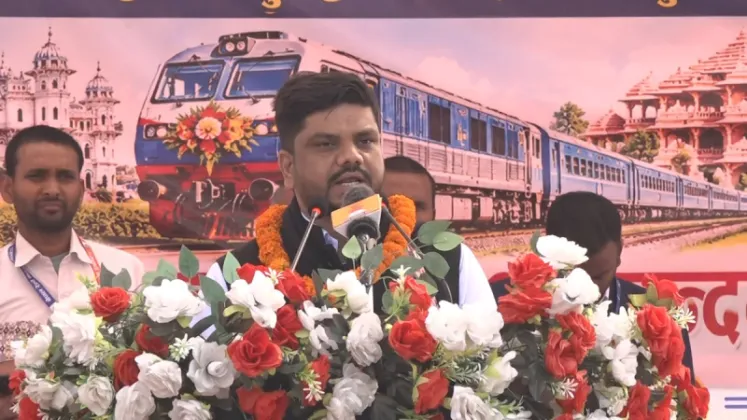
The newly launched Ayodhya–Janakpur rail service is expected to significantly boost religious and cultural tourism between the two historic cities, according to Minister for Youth, Labour and Employment Ramji Yadav. Speaking at a programme in Janakpurdham on Tuesday, Minister Yadav said the rail service, which has been named the Saryu–Kamala Express, will open new doors for tourism while also generating fresh opportunities for local employment, trade and entrepreneurship. The minister's remarks come shortly after the service began operations on the route connecting Ayodhya in India's Uttar Pradesh state with Janakpurdham, the cultural heartland of the Mithila region in Nepal.
A boost for religious and cultural tourism
Minister Yadav highlighted that the Ayodhya–Janakpur rail link carries deep religious significance for millions of devotees in both countries. Ayodhya, regarded as the birthplace of Lord Ram, and Janakpurdham, the ancient capital of King Janak and the birthplace of Goddess Sita, are two of the most revered sites in the Hindu world. The direct rail connection between the two cities allows pilgrims to travel conveniently between sites that are central to the Ramayana tradition.
According to the minister, the Saryu–Kamala Express is not merely a transport project but a bridge between two ancient civilisations bound by shared history, faith and culture. He expressed confidence that the ease of travel will encourage a growing number of pilgrims and cultural tourists from both Nepal and India to visit Janakpurdham, which has long been a major destination for Hindu devotees, particularly couples who come to celebrate wedding anniversaries and participate in the city's famed religious festivals.
New opportunities for employment and entrepreneurship
Beyond tourism, Minister Yadav placed strong emphasis on the economic potential of the rail service. He said the operation of the Saryu–Kamala Express will create new opportunities for local employment in and around Janakpurdham, as increased visitor numbers generate demand for services ranging from hospitality and food to local transport and guiding.
The minister also underlined the prospects the rail link offers for trade and entrepreneurship. With more people and business activity flowing along the corridor, local traders, hoteliers and small entrepreneurs in the Mithila region stand to benefit from the expanded market access that a cross-border rail connection provides. He encouraged residents of Janakpurdham and surrounding areas to make the most of the opportunities that come with improved connectivity, positioning the service as a catalyst for local economic development.
A milestone in Nepal–India connectivity
The launch of the Ayodhya–Janakpur rail service marks an important milestone in cross-border connectivity between Nepal and India. Janakpurdham, located in Nepal's Madhesh Province, has been a focal point of religious tourism cooperation between the two neighbours, and the direct rail link is seen as a practical expression of that partnership.
The service was officially flagged off from Ayodhya on Friday, with the train arriving in Janakpurdham the same day, formalising the long-awaited connection between the two cities. The route takes its name from the Saryu river, which flows through Ayodhya, and the Kamala river, which flows through the Mithila region of Nepal, symbolically joining the two landscapes along the historic pilgrimage path.
Optimism for Janakpurdham's future
Minister Yadav's remarks at the Janakpurdham programme reflect the optimism among local leaders and communities that the rail service will transform the city's tourism economy. As the administrative and spiritual centre of Dhanusha district, Janakpurdham hosts thousands of pilgrims each year, particularly from India, and improved rail access is expected to raise those numbers considerably.
The government of Nepal has in recent years prioritised infrastructure and connectivity projects aimed at unlocking the tourism potential of the Madhesh region, and the Saryu–Kamala Express is among the most prominent outcomes of that effort. With religious tourism forming a major pillar of Nepal's broader tourism strategy, the Ayodhya–Janakpur rail corridor is poised to strengthen the country's position as a destination for cultural and pilgrimage travel.
The minister's comments, reported on Tuesday, were published by Nepali media outlets including Rato Pati and Gorkhapatra Online, which noted his emphasis on the combined benefits of tourism promotion, employment creation and entrepreneurial growth along the new rail corridor.
As the Saryu–Kamala Express settles into regular operation, attention will now turn to how effectively the service can be integrated with local tourism infrastructure in Janakpurdham, and whether the expected surge in pilgrim arrivals translates into lasting economic gains for the communities along the route.