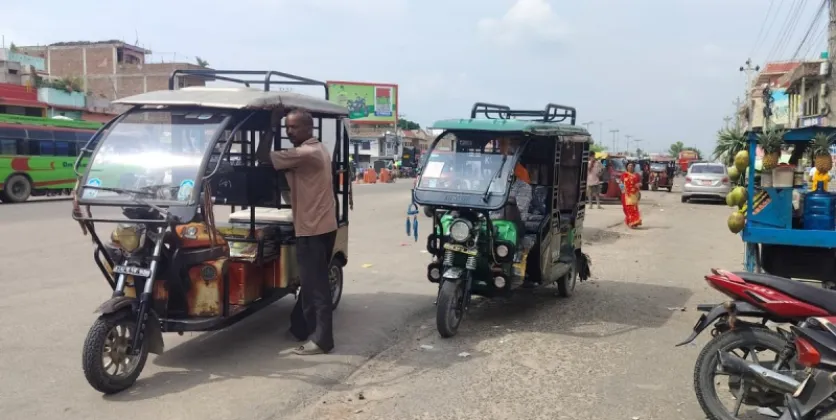
Travel has become noticeably easier for residents of two remote corners of Banke district, as auto-rickshaws have begun operating in Rapti Sonari and Narainapur rural municipalities. The arrival of the three-wheeler service addresses a long-standing complaint among people in these areas, who for years struggled to find a vehicle even for the shortest of trips. According to reports by RatoPati and Pradesh Khabar, the introduction of the service has brought visible relief to local residents, for whom even routine movement had long been a challenge.
A long-standing transport gap
For people living in the remote rural areas of Rapti Sonari and Narainapur, the difficulty was never about covering long distances alone. It was the everyday, short-distance trips, the kind that most households must make again and again, that proved the hardest to manage. Finding a vehicle for such journeys had been a persistent struggle, leaving residents to depend on chance, on irregular options, or on their own feet.
That gap in mobility is what the new auto-rickshaw service is now filling. With three-wheelers available for short hops, residents no longer face the same uncertainty when they need to move from one village to another or to a nearby bazaar. The change, as the reports describe it, has made travel easier and has been received with relief by the local population.
The problem the service addresses is a familiar one across rural Nepal. Public transport in the country tends to concentrate along main highways and between larger towns, while settlements lying away from those corridors are often left with thin or unreliable options. In such places, the availability of even a small vehicle for local travel can transform daily routines, and that is precisely the role auto-rickshaws are now playing in these two municipalities.
Where the service is operating
Banke district lies in the southwestern plains of Nepal, within Lumbini Province, with its headquarters at Nepalgunj, one of the busiest commercial centres in the western Terai. Rapti Sonari and Narainapur are rural municipalities of the district, located away from the urban hub where most of the district's transport activity is concentrated. It is in these more remote areas that vehicle availability has historically been weakest.
The two municipalities cover spread-out villages where distances between homes, markets and service centres can still require a ride. Until now, residents of these areas had long struggled to find vehicles for such short-distance trips, a burden that fell on daily life in ways that urban commuters rarely experience. The introduction of the auto-rickshaw service directly targets that everyday gap.
Why the auto-rickshaw fits
The choice of the auto-rickshaw as the vehicle to serve these areas reflects its practical strengths for rural terrain. Across the Terai, the three-wheeler has become a common sight precisely because it suits conditions that larger public vehicles do not.
- Manoeuvrability: Auto-rickshaws can operate on narrow and rough village roads where buses and microbuses often cannot conveniently run.
- Suitability for short trips: The vehicle is designed for the kind of short-distance, point-to-point travel that residents of Rapti Sonari and Narainapur most needed.
- Affordability: Shared auto-rickshaw rides are typically within reach of rural households, making frequent local journeys sustainable.
- Flexibility: Operators can serve scattered settlements without fixed large-scale infrastructure, responding to where demand actually exists.
These qualities have made the auto-rickshaw a popular last-mile option in many parts of the plains, and its entry into Rapti Sonari and Narainapur follows the same logic: bring a vehicle that matches the distance, the road and the paying capacity of the local population.
What easier travel means for residents
The immediate outcome, as reported, is relief. People who had long struggled to find vehicles for short trips now have a service they can turn to, and that shift carries weight beyond mere convenience. Reliable local transport shapes whether students can reach schools without long walks, whether patients can get to health facilities in time, and whether families can make routine market trips without losing hours of the day.
For the residents of these remote areas, the service converts trips that once required planning, waiting or walking into simple, ordinary journeys. In municipalities located away from Banke's transport hubs, that kind of dependable short-distance connectivity is not a small matter; it is the difference between being linked to the district's economic and social life and remaining cut off from it.
The operation of auto-rickshaws in Rapti Sonari and Narainapur also signals a gradual extension of transport services into parts of Banke that have historically been underserved. While larger infrastructure projects often capture attention, it is improvements at this scale, a vehicle on the village road, that residents feel first and most directly. For now, the people of the two rural municipalities have what they had long lacked: a ready ride for the short trip, and a lighter daily burden as a result.