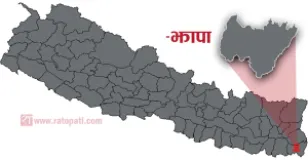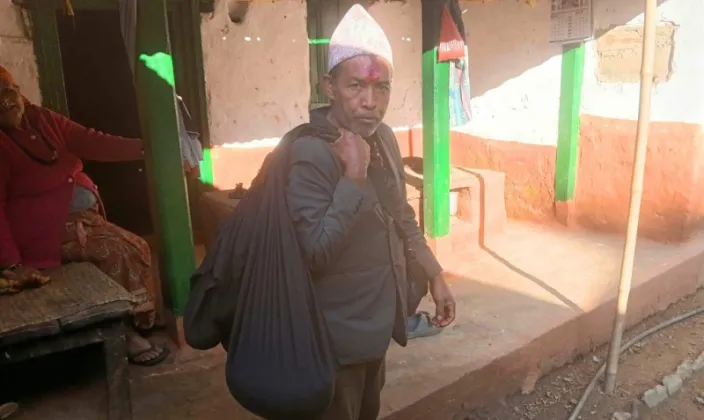
In the hills of Bhojpur district, one man is holding on to an occupation that the world around him has all but forgotten. Arjun Jogi of Yangpang, in Arun Rural Municipality-1, has spent the past two decades practicing the traditional 'Pheri' profession, an ancestral trade that is now on the verge of disappearing from Nepal's cultural landscape. Practiced through the seasons of Kartik, Chaitra and Shrawan, the occupation survives in this corner of eastern Nepal largely because Jogi has refused to let it fade, even as modern lifestyles and changing social conditions have stripped the tradition of its once-familiar place in community life.
A Trade Handed Down Through Generations
The Pheri profession was not something Jogi adopted by choice alone. Like many traditional occupations of Nepal's hill districts, it was passed down to him through generations of his family, carrying with it the weight of inheritance and obligation. For twenty years, he has continued the work of his forefathers in Yangpang, becoming one of the last active practitioners of a trade that once formed part of the social fabric of settlements along the Arun valley, after which Arun Rural Municipality takes its name.
His persistence is notable at a time when such occupations are vanishing across the country. As a recent report published on Nepal Press observed, the very word 'Pheri' is disappearing from everyday use, and Jogi is the one carrying the tradition forward. When the vocabulary of a profession fades from common speech, the practice itself rarely survives for long, which makes his two-decade commitment all the more significant.
Why the Tradition Is Fading
According to reporting by Pradesh Khabar, the occupation has lost its appeal due to modern lifestyles and changing social conditions. The story of Pheri's decline mirrors a wider pattern seen in hill communities throughout Nepal, where traditional trades that once depended on close-knit rural society have struggled to retain relevance as ways of life transform.
The pressures on such heritage are cumulative rather than sudden:
- Lifestyles have modernized, and the routines that once sustained customary occupations have weakened.
- Social conditions have changed, reducing the place of generation-old practices in daily community life.
- The appeal of the trade has diminished to the point where it is now described as being on the verge of disappearance.
What remains is a profession practiced by a shrinking handful of people. In Yangpang, that handful has, in effect, become one man.
A Profession Tied to the Seasons
Unlike occupations practiced year-round, Jogi's work follows a rhythm fixed in the traditional Nepali calendar. He practices the Pheri profession during three specific months:
- Kartik, the seventh month of the Bikram Sambat calendar, falling roughly between mid-October and mid-November.
- Chaitra, the final month of the Nepali year, running from approximately mid-March to mid-April.
- Shrawan, the fourth month, spanning roughly mid-July to mid-August and regarded as an especially significant period in Nepal's religious and cultural life.
This seasonal pattern reflects how deeply traditional occupations in Nepal are woven into the agricultural and ritual calendar of the hills. Rather than being a continuous trade, Pheri surfaces at particular times of the year, and its survival depends on practitioners like Jogi observing that calendar with regularity. His decision to keep marking those months, year after year, is what separates the tradition from being remembered only as history.
Keeping a Vanishing Heritage Alive
The case of Arjun Jogi highlights the fragile condition of intangible cultural heritage in Nepal's rural municipalities. Traditions like Pheri do not survive in museums or monuments; they live only in the hands of the people who practice them and in the communities that continue to recognize their meaning. When the last practitioner stops, an entire body of inherited knowledge, language and custom disappears with them.
Jogi's twenty years of quiet persistence in Yangpang represent the other path, one in which a single individual's continuity becomes the lifeline of a tradition. As the headline of the Nepal Press report put it, the word 'Pheri' may be disappearing, but Arjun is carrying on the tradition.
Whether the profession outlives him remains uncertain, given the social changes reshaping communities like those in Bhojpur. What is certain is that for now, in Arun Rural Municipality-1, the sound of an ancestral occupation being practiced in Kartik, Chaitra and Shrawan has not fallen silent, and the generations who built the tradition have at least one faithful successor.