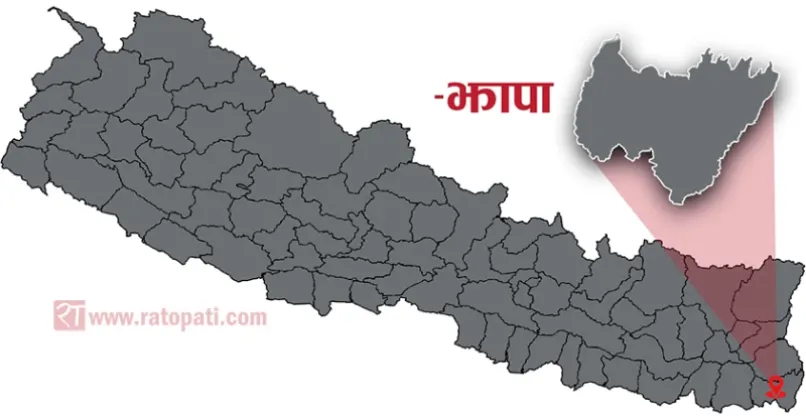
Hukahuki, the festival that indigenous communities of Nepal's Jhapa district celebrate on the day of Laxmi Puja during Tihar, is running short of its most essential material: santhi, the dried stalk of the jute plant. Reports from Bhadrapur and Birtamod say that shrinking jute cultivation has made santhi scarce, leaving families who observe the festival struggling to find it. Stalks that were once easily available in villages now have to be brought in from other districts in some areas, and a single bundle costs one hundred rupees.
A festival built around santhi
Hukahuki is observed on Laxmi Puja day, one of the principal days of Tihar, by communities across Jhapa in the eastern Tarai. Laxmi Puja is the day on which households across Nepal worship the goddess Laxmi, and for the indigenous communities of Jhapa it is also the day of Hukahuki. At the centre of the observance is santhi, the dried jute stalk. As long as jute was grown around village settlements, obtaining the stalks was never a problem: they were easy to find close to home and required no purchase.
That situation has changed. According to RatoPati, jute cultivation in the district has narrowed to the point where the supply of santhi can no longer match the demand created by the festival. What was once gathered freely is now searched for, priced and, in some places, brought in from other districts.
Scarcity from Birtamod to Bhadrapur
The shortage is being felt across the district, with reports from Bhadrapur and Birtamod describing similar difficulties. In the market areas around Birtamod, Kanakai and Bhadrapur, santhi now has to be brought from other districts. A bundle sells for one hundred rupees, a cost that simply did not exist when the stalks were still grown locally.
The price matters beyond a single purchase. The amount of santhi needed for Hukahuki is rarely limited to one bundle, so households that once spent nothing on the festival's central material now face a new and unfamiliar expense. Pradesh Khabar and Khabarhub both reported on the difficulty families are having in securing enough stalks as Tihar approaches.
The contrast with the past is sharp. Santhi was once so easily available in the villages that its supply was never in question. Today it is a market item whose price and availability are uncertain, and whose presence in the district now depends on transport from elsewhere.
Indigenous communities carry the tradition
The communities struggling most with the shortage are the indigenous groups for whom Hukahuki is an annual tradition. Among those affected are:
- the Rajbanshi
- the Tajpuriya
- the Gangai
- the Majhi
These communities have marked Laxmi Puja day with Hukahuki for generations, and santhi has been part of the celebration throughout. The reports note that all four groups are finding it difficult to obtain the stalks, a difficulty that stems directly from the decline of jute farming in the villages where they live.
The concern is cultural as much as it is economic. When the raw material of a festival disappears from local fields, the celebration itself comes under pressure. Families must either pay more for stalks brought from outside the district or search harder for what little is locally available.
The slow retreat of jute
The shortage traces back to a single fact: jute is no longer farmed in Jhapa the way it once was. As cultivation has declined, the dried stalks that are a by-product of the jute harvest have disappeared from the places where they used to be plentiful. The reports from Bhadrapur and Birtamod connect the festival's supply problem directly to this agricultural shift.
The consequences reach beyond the farm. A shrinking crop has removed a raw material from everyday village life, turned it into a priced commodity and pushed its supply outside the district. For Hukahuki, that means santhi now arrives, when it can be found at all, from somewhere else.
For this Tihar, families across Jhapa are preparing as best they can, paying one hundred rupees a bundle where santhi is on sale and searching for stock brought in from other districts. Whether next year's Hukahuki finds santhi close to home again depends on whether jute can hold on to a place in the district's fields.