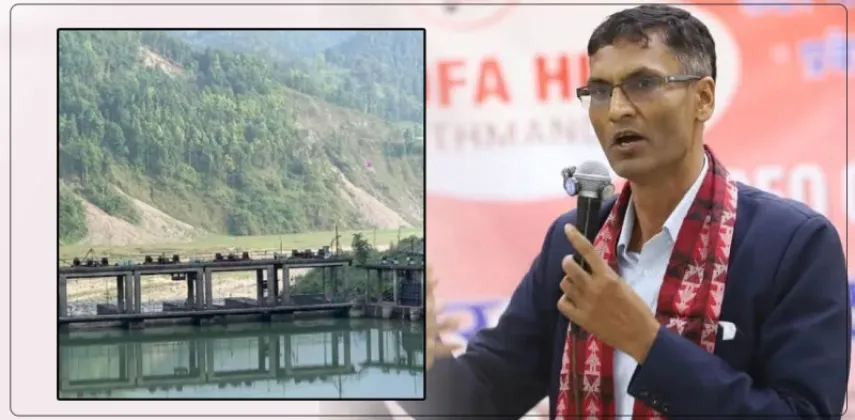
A bitter internal dispute has erupted at Aankhukhola Hydropower Company Limited, a hydropower developer based in Ringne, Dhading, after shareholder and elected director Ram Prasad Sapkota publicly objected to the company's management and demanded the return of approximately Rs 50 million. The confrontation, which centers on the firm's investment decisions, its financial liabilities and the working style of its board of directors, has pushed questions of corporate governance and shareholder protection into the open. Sapkota argues that the money invested by shareholders is now at risk, and his refund demand marks an unusual public break between a sitting director and the very board on which he serves. The dispute was reported by Rato Pati and Aaja ko Artha.
A Director Turns Against the Board
Sapkota, who holds a seat on the company's board as an elected director, has gone public with his objections to how Aankhukhola Hydropower is being run. According to reports, his criticism covers three broad areas:
- The company's investment decisions, including a contested move involving Rs 200 million
- The firm's financial liabilities, which he believes expose shareholder capital
- The working style of the board, which he says has contributed to the company's troubles
The fact that these objections come from inside the boardroom gives the dispute added weight. Elected directors are expected to participate in and endorse board decisions, so a director publicly demanding his investment back signals a deep split within the company's own leadership. In his public statements, Sapkota has claimed that the capital injected by shareholders is at risk, a serious allegation for any company that depends on continued investor confidence to fund construction, operations and loan servicing.
The Rs 200 Million Investment and the Rs 2 Billion Rights Issue
At the heart of the row are two major financial moves. The first is a decision relating to a Rs 200 million investment, which has become one of the flashpoints between Sapkota and the company's management. The second, and by far the larger, is a proposed rights share issue worth Rs 2 billion, a plan that would ask existing shareholders to inject fresh capital into the company.
Rights shares are among the most common fundraising instruments used by companies in Nepal, and hydropower firms in particular have relied on them heavily to finance project construction and strengthen their capital structures. Under a rights issue, shares are offered first to existing shareholders in proportion to their holdings. A Rs 2 billion rights issue is therefore not a routine administrative matter: it is a direct call on every shareholder to either put up additional money or risk seeing their stake diluted.
For Sapkota, the combination of a large proposed rights issue and unresolved questions about the company's existing liabilities appears to have been the trigger for his public break. His position is that shareholders should not be asked to commit further funds while the underlying investment decisions and financial obligations of the company remain disputed.
What Is at Stake for Shareholders
The immediate question raised by the dispute is the safety of the roughly Rs 50 million that Sapkota says he has invested in the company and now wants returned. His demand frames the issue in blunt terms: if the company's investment decisions and liabilities are as problematic as he suggests, then shareholder capital is exposed, and the responsible course is to return that capital rather than raise more.
For smaller shareholders who are not on the board, disputes of this kind carry particular significance. Individual investors in Nepali hydropower companies often have limited visibility into boardroom deliberations and must rely on public disclosures and the conduct of directors to gauge a company's health. When an elected director himself states that shareholder investments are at risk, that signal can unsettle the very base of investors the company would need to tap through its Rs 2 billion rights issue.
Dhading district, where the company is based, hosts a range of small and medium hydropower projects that have drawn investment from local residents as well as the wider investing public. Firms of this kind typically operate with boards drawn from among major shareholders and local stakeholders, which makes internal disagreements especially consequential: the people financing the project and the people governing it are often part of the same community.
A Company at a Crossroads
The standoff leaves Aankhukhola Hydropower facing a difficult stretch. On one side stands a director demanding a Rs 50 million refund and openly questioning the board's investment decisions, financial liabilities and working style. On the other stand the company's plans, which include the Rs 200 million investment decision and the ambitious Rs 2 billion rights share issue, both of which depend on shareholder trust for their success.
Resolving the dispute will likely require the company to address Sapkota's allegations directly, either by clarifying the rationale behind the contested investment and the extent of its liabilities, or by finding a negotiated settlement over his stake. Until then, efforts to raise fresh capital face an uncomfortable reality: the company's own director has told the market that shareholder money is at risk.
No detailed public response from the company's board has been reported so far, and it remains to be seen whether the Rs 2 billion rights issue will proceed as planned or whether the growing dispute will force a rethink of the company's financial strategy.