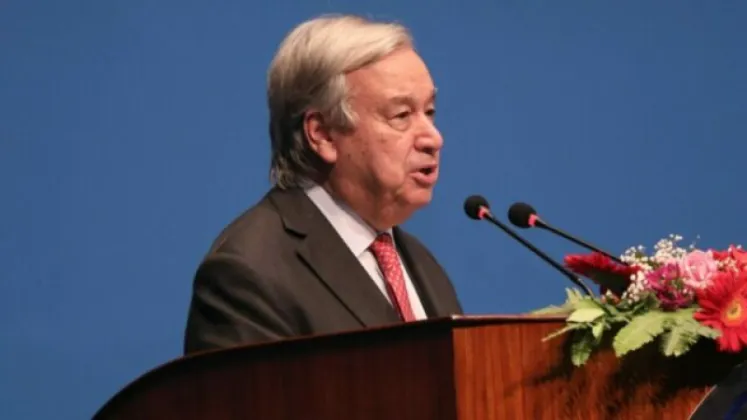
United Nations Secretary-General Antonio Guterres has called for restraint amid escalating hostilities in Yemen, condemning Houthi attacks against civilian targets in Saudi Arabia and declaring that Yemen needs a political horizon. The UN chief, who arrived in Egypt on Saturday, said wars are deepening global inequalities and intensifying economic pressures, and he urged an end to the widening of conflicts, stronger protection for civilians and greater space for diplomacy. He shared the remarks in posts on X, according to Khabarhub.
Guterres condemns attacks on civilians as hostilities escalate
At the centre of the Secretary-General's message was a direct condemnation of the Houthi attacks against civilian targets in Saudi Arabia, delivered as hostilities connected to Yemen continue to escalate. Guterres paired that condemnation with an explicit appeal for restraint, warning against any further widening of the conflict and stressing that civilians must be protected.
The statement places the protection of civilians at the heart of the United Nations' response to the escalating situation. By singling out attacks on civilian targets, the Secretary-General drew a clear line between combatants and non-combatants, reinforcing the position that people who are not part of the fighting should never come under attack, whatever the circumstances of the broader confrontation.
Restraint before the conflict spreads further
Guterres's call for restraint was addressed to the parties involved as tensions around Yemen intensify. His warning against the widening of conflicts reflects the danger he clearly sees: that escalating hostilities do not remain contained, but instead expand, drawing in more targets, more territory and more suffering.
In his framing, restraint is not simply a pause in fighting but a deliberate choice by those involved to prevent the situation from deteriorating further. The appeal came alongside his insistence that Yemen needs a political horizon, linking the immediate demand for calm to a longer-term need for a way out of the conflict altogether.
Wars deepening inequality and economic pressure, UN chief warns
Beyond the immediate situation in Yemen and Saudi Arabia, the Secretary-General used his remarks to set the escalating hostilities within a wider global context. Wars, he said, are deepening global inequalities and intensifying economic pressures, compounding hardship far beyond the front lines of any single conflict.
In his assessment, the cost of war is not measured only in lives and destruction. Conflict, in his telling, widens the gaps between and within societies and adds to the economic strains that people around the world are already facing. It is against that backdrop that he urged an end to the widening of wars, presenting diplomacy as the alternative to a world in which conflicts multiply and their consequences spread.
The message was unambiguous: widening conflicts and growing inequality are intertwined problems, and addressing them requires pulling back from escalation rather than pushing further into it.
A political horizon for Yemen and space for diplomacy
The most pointed element of the Secretary-General's message concerned Yemen itself. Yemen, he said, needs a political horizon, language that points to the need for a credible political path out of the conflict rather than a continuation of hostilities. The remark underscored his position that the escalation must be matched, and ultimately replaced, by a political process.
Alongside that call, Guterres laid out a clear set of demands, urging:
- An end to the widening of conflicts, so that existing wars are not allowed to expand into broader confrontations
- The protection of civilians, including condemnation of attacks directed at civilian targets
- Greater space for diplomacy, so that political efforts are not crowded out by escalating violence
Taken together, the three points form the backbone of the Secretary-General's appeal. Restraint protects civilians in the short term; a political horizon offers Yemen a destination beyond the fighting; and diplomatic space is what makes that journey possible.
Message delivered from Egypt at a moment of escalation
The remarks came as Guterres arrived in Egypt on Saturday, and the UN chief chose to deliver them publicly through posts on X, putting his position before a global audience at the start of the visit. The timing of the message, coinciding with escalating hostilities in Yemen and Houthi attacks on civilian targets in Saudi Arabia, gave particular weight to his warnings about conflicts widening.
For the United Nations' top official, the sequence of his message reflected its logic: condemn attacks on civilians, call for restraint, warn against further widening of the wars, and insist that diplomacy be given the room it needs to work. His answer to the escalation was not retaliation but de-escalation, and his answer to the absence of a way forward in Yemen was the demand for a political horizon.
As the situation he described continues to develop, the Secretary-General's posts on X stand as the clearest statement yet of the United Nations' position on the escalating hostilities: that the widening of wars must end, that civilians must be protected, and that Yemen must be given the political horizon its people need.