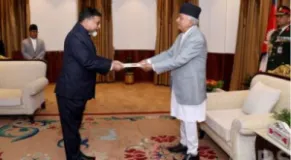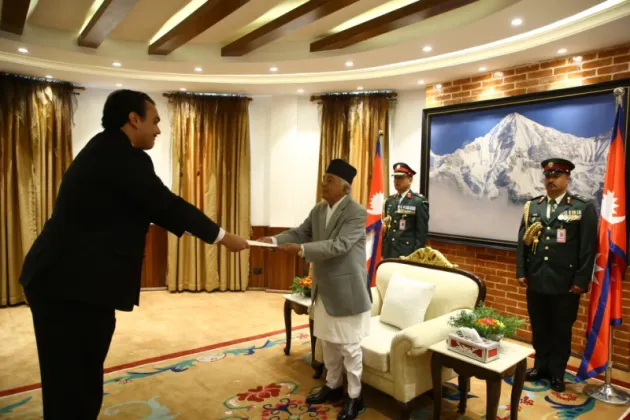
Three newly appointed ambassadors presented their letters of credence to the President of Nepal on Friday, formally taking up their diplomatic responsibilities in the country. The credentials were submitted at a ceremony held at the President's Office in Kathmandu, with the new envoys representing three countries, among them India. With the acceptance of their credentials, the ambassadors are now officially accredited to Nepal's head of state, clearing the way for them to begin the full range of their duties, from engaging with the government to representing their nations' interests in the capital.
A Formal Welcome at the President's Office
The ceremony followed the established protocol for receiving foreign envoys in Nepal. Letters of credence are official documents signed by the head of state of the sending country, certifying that the bearer is its accredited ambassador and requesting that the receiving head of state give full recognition to everything the envoy says and does on that country's behalf. Their presentation is among the most ritualised moments in international diplomacy, typically marked by formalities that underscore the mutual respect between two states.
Friday's event placed three such documents before the President in a single sitting, an arrangement commonly used when several newly appointed ambassadors arrive in Kathmandu around the same time. According to reports by Nepal Views, Nepal Samaya and Thaha Khabar, the three envoys handed over their credentials at the President's Office, where they were received in keeping with standard state protocol.
Why the Credentials Matter
In practical terms, the letter of credence is the document that turns an appointed ambassador into a functioning one. Until credentials are presented and accepted, an envoy does not formally hold the title of ambassador to the host country and generally refrains from official engagements in that capacity. Once the President accepts the letters, the envoys' accreditation is complete, allowing them to convey their governments' positions, attend official functions as ambassadors and negotiate on behalf of their capitals.
The acceptance of credentials also carries symbolic weight. It signals that the receiving state recognises the envoy's government and is prepared to maintain diplomatic relations at the ambassadorial level, a point of significance for any country looking to deepen its ties with Nepal. For the envoys themselves, the ceremony marks the moment their diplomatic work in Nepal formally begins.
India Among the Three Envoys
The presence of India's newly appointed ambassador among the three envoys lends the ceremony added weight. India and Nepal share a long open border and a relationship built on dense ties of trade, culture, religion and family that few pairs of neighbouring countries can match. The arrival of a new Indian envoy is therefore closely watched by observers of Nepal's foreign policy, given the breadth of cooperation between the two capitals.
New Indian ambassadors traditionally engage early with Nepal's political leadership, and their working agendas typically span trade and transit, cross-border connectivity, energy cooperation, development partnership and people-to-people exchanges. While the specific priorities of the incoming envoy were not detailed in the reports of Friday's ceremony, the accreditation places the representative of one of Nepal's most important partners formally in position in Kathmandu.
The reports identified India as one of the three countries represented at the ceremony, but did not name the other two nations whose ambassadors presented their credentials alongside the Indian envoy, nor the individual envoys themselves.
What Comes Next for the New Ambassadors
The presentation of credentials is consistent with long-standing diplomatic practice, codified in the Vienna Convention on Diplomatic Relations, under which an ambassador is regarded as having assumed their functions from the moment credentials are presented. In Nepal, such ceremonies are held at the President's Office, reflecting the constitutional role of the President as the head of state who receives and accredits foreign envoys.
Once accredited, the three new ambassadors are expected to follow the ceremony with the customary round of courtesy calls, including meetings with senior officials of the Ministry of Foreign Affairs and other members of the diplomatic corps based in Kathmandu. These early exchanges are traditionally where each envoy outlines the priorities their government hopes to pursue during their tenure.
For Nepal's foreign policy establishment, the arrival of three new ambassadors at once represents a small but meaningful refresh of the diplomatic community in the capital. The envoys will now begin building working relationships across Nepal's political spectrum and engaging with the ministries most relevant to their bilateral agendas, from trade and connectivity to development cooperation.
While the initial reports of Friday's ceremony were brief, the formal start of the three envoys' tenures, including that of the Indian ambassador, sets the stage for the bilateral engagements that will follow in the months ahead. As the new ambassadors settle into their roles, their first official calls on Nepal's leadership are expected to shape the tone of each country's diplomacy in Kathmandu.