As Dashain festivities unfold across Nepal, the Tharu community is once again observing the country's biggest festival through its own distinctive customs, preserving rituals that set its celebrations apart from those seen elsewhere in the country. According to an explainer published by Nepal Views and Pradesh Khabar, the community's Dashain runs from Saptami, the seventh day of the festival, through to the day of Tika, and features practices such as wearing white tika, offering dhikri, and receiving tika from the Guruwa and village elders. The celebrations also come alive with the Sakhiya dance, a performance that reflects the community's original customs.
Dashain with a Tharu Character
Dashain is observed throughout Nepal as a time of blessings, family gatherings and celebration, but within Tharu households the festival carries a character all of its own. Rather than simply adopting the practices that dominate elsewhere, the Tharu people have maintained a parallel set of traditions handed down through generations. The explainer highlights how these customs remain central to the community's observance of the festival, from the rituals that begin on Saptami to the concluding celebrations on Tika day.
The distinction is not merely a matter of style. Each element of the Tharu Dashain, from the colour of the tika to the food that is offered and the dances that are performed, is rooted in the community's own cultural heritage. Taken together, these practices show how Nepal's biggest festival can be celebrated in different ways while still retaining its core spirit of reverence, renewal and togetherness. For the Tharu community, observing Dashain in its own manner is also a way of keeping its identity visible at a time when the festival fills the entire country.
From Saptami to Tika Day
The Tharu observance follows the rhythm of the Dashain calendar, beginning on Saptami and continuing through to the day of Tika. Across these days, households and villages carry out a series of rituals that prepare the community for the festival's most important moments. The period is marked by acts of offering, blessing and communal gathering, each carrying meaning within the Tharu tradition. The key practices that define the celebration include:
- Wearing white tika in place of the red tika commonly seen during Dashain
- Making offerings of dhikri, a traditional preparation of the community
- Receiving tika from the Guruwa and from village elders
- Performing the Sakhiya dance, which reflects the community's original customs
The White Tika Tradition
Among the most striking of these practices is the wearing of white tika. While the red tika is a defining image of Dashain in much of Nepal, members of the Tharu community instead mark the festival with white tika. This tradition, highlighted in the explainer as one of the community's original customs, gives the Tharu celebration a visual identity that is immediately recognisable and distinctly its own.
Blessings from the Guruwa and Village Elders
The community's celebrations also include receiving tika from the Guruwa and from village elders. The Guruwa holds a respected position in the Tharu community as its traditional religious figure, and tika received from the Guruwa forms an important part of the festival's spiritual life. The practice underlines the collective nature of the Tharu Dashain, in which blessings are shared not only within individual families but across the village as a whole.
Village elders play an equally significant role. By receiving tika from them, younger members of the community show respect for the continuity and knowledge that the elders represent. The custom reinforces the social bonds that hold Tharu villages together during the festival season and helps ensure that the traditions are passed naturally from one generation to the next.
The Offering of Dhikri
Food traditions occupy a central place in the festivities as well. As part of the rituals observed between Saptami and Tika day, the community makes offerings of dhikri. The presence of dhikri in the Dashain rituals ties the celebration to the community's culinary heritage, ensuring that the tastes of the festival remain distinctly Tharu even as the wider country celebrates in its own ways.
Sakhiya Dance: A Living Expression of Heritage
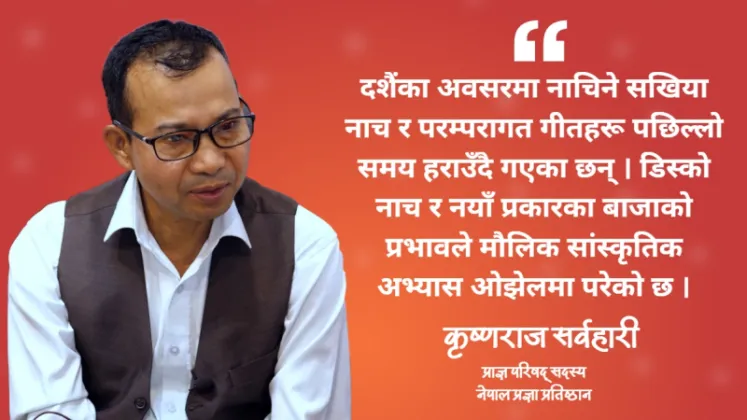
No account of the Tharu Dashain would be complete without the Sakhiya dance. Featured as part of the community's celebrations, the dance is described as a reflection of the Tharu people's original customs. Its performance during the festival connects the Dashain of today with the traditions of the past, making it a living expression of the community's heritage.
The dance adds colour and energy to the festival period and demonstrates how closely the community's cultural and religious life are intertwined. For the Tharu people, Dashain is not only a time of ritual observance but also an occasion on which their art forms are displayed, practised and renewed before the wider community.
A Reminder of Nepal's Festive Diversity
The explainer, with the story also carried by Globalaawaj, serves as a reminder that Dashain in Nepal is not a single, uniform celebration. Communities across the country observe the festival through their own customs, and the Tharu traditions of white tika, dhikri offerings, blessings from the Guruwa and elders, and the Sakhiya dance offer a vivid example of this diversity. As these practices continue from Saptami through Tika day, they carry forward a cultural inheritance that makes the Tharu Dashain a celebration of both faith and identity.