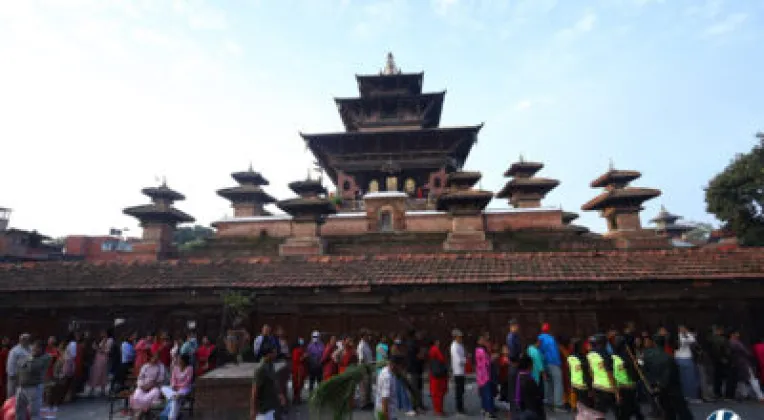
The Taleju Bhawani temple, situated inside the Hanuman Dhoka Durbar area in the heart of Kathmandu, was opened to devotees on Tuesday, the day of Maha Navami, allowing worshippers to pay their respects from 5 am to 6 pm. The temple, listed as part of a World Heritage Site, opens its doors to the public only once a year, on Maha Navami, and devotees began queuing from early morning to secure darshan of the goddess at one of the capital's most revered shrines.
For the thousands who consider a visit to the shrine an essential part of the festival, the day carried special weight, as a missed opportunity means waiting an entire year for another chance to enter the temple.
A shrine that opens once a year
Unlike most temples across the Kathmandu valley, the Taleju Bhawani temple remains closed to the general public throughout the year. Maha Navami, the day on which the temple opens, is thus the only occasion on which ordinary devotees can step inside the historic shrine and offer their prayers directly to the goddess.
This year's opening followed the familiar pattern that has made the temple's single-day darshan one of the most anticipated moments of the festival season in the capital.
The key details of the opening were:
- The temple opened to devotees at 5 am on Tuesday and remained accessible until 6 pm.
- Maha Navami is the only day of the year on which the temple is opened to the public.
- Devotees queued from early morning, well before the gates opened, to receive darshan.
- The shrine lies within the Hanuman Dhoka Durbar area in central Kathmandu, which is recognized as a World Heritage Site.
The early morning crowds reflected the devotion the shrine commands. With the temple closed for the rest of the year, worshippers treat the Maha Navami opening as a rare and precious opportunity, and many arrived hours in advance to secure their place in the queue that wound through the historic palace complex.
The legend behind the tradition
The temple's once-a-year opening is rooted in a legend that has been passed down for centuries. According to the belief, King Jayaprakash Malla, who ruled in the 17th century, is said to have played tripasha, a game of chance, with the goddess Taleju Bhawani herself. The goddess would join the king for the game, making the encounters a cherished privilege of the royal court.
The arrangement came to an abrupt end when the king cast an evil eye on the goddess. Angered by his gaze, Taleju Bhawani disappeared, bringing the meetings between the deity and the monarch to an end.
The story does not end with the disappearance, however. After the king apologized, the goddess is said to have offered a concession: she promised to appear only once a year. It is in keeping with this promise, devotees believe, that the temple opens its doors on Maha Navami, giving the public a single day each year to worship the goddess within her temple.
For the faithful, the legend explains both the exclusivity and the sanctity of the occasion. The goddess who withdrew from regular appearance is believed to grace the temple on this one day, and devotees who line up for darshan see themselves as receiving a blessing that cannot be obtained at any other time.
Arrangements for smooth darshan
With such large crowds expected for the single-day opening, the authorities made preparations to manage the flow of devotees. The Hanuman Dhoka Durbar Care Office said that arrangements had been made for smooth darshan, allowing worshippers to move through the temple in an orderly manner from the early morning hours until the gates closed in the evening.
The Care Office's preparations were aimed at ensuring that the long queues, which formed well before dawn, could be accommodated across the extended opening hours of 5 am to 6 pm. The window, stretching across the daylight hours of Maha Navami, gave devotees ample time to visit the shrine during the course of the day.
Heritage and faith in the heart of Kathmandu
The Taleju Bhawani temple occupies a special place in the religious and historical landscape of Kathmandu. Located within the Hanuman Dhoka Durbar area, the temple stands amid a palace complex that carries centuries of history and is part of the capital's World Heritage recognition. Its annual opening on Maha Navami, as reported, draws attention not only to the shrine itself but to the wider heritage area in which it stands.
For the devotees who queued through Tuesday morning, the occasion combined faith, festival and heritage in a single visit. By the time the gates closed at 6 pm, worshippers had made the most of the one day in the year on which the goddess Taleju Bhawani is traditionally said to appear within her temple, and the shrine once again shut its doors, awaiting the next Maha Navami to reopen them.