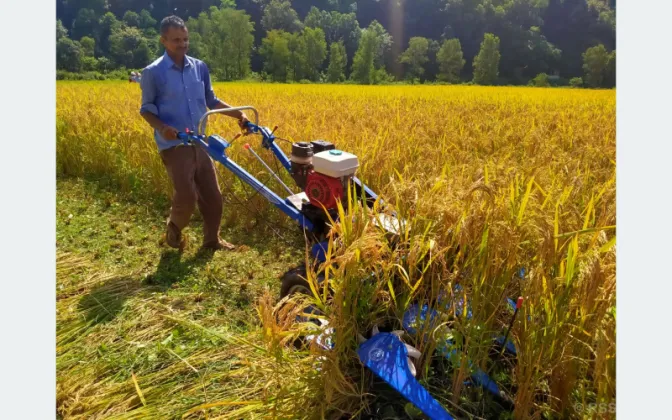
The Agricultural Development Resource Centre in Yabadi, Waling-1, Syangja, has begun using an advanced rice-harvesting machine for the first time as it promotes modern machinery to reduce production costs. The centre, which covers 11 districts of Gandaki Province, says the use of technology is increasingly important as expenses in the agriculture sector continue to rise. Office chief Sudip said modern methods and equipment need to be introduced to address that cost pressure.
A new step in mechanised rice harvesting
The centre’s use of an advanced rice-harvesting machine marks a first for the office. Its adoption forms part of a wider emphasis on modern machinery and equipment in agricultural work, with reducing production costs identified as a key objective. The centre’s area of responsibility extends across 11 districts in Gandaki Province, making its technology focus relevant to a broad regional mandate, although no details were provided on how widely the machine will be used or which locations it will serve.
Rice harvesting is the specific activity for which the centre has begun using the advanced machine. The available information does not identify the machine’s model, capacity or technical features, nor does it give details of the number of farmers or farms involved. The centre has also not reported a measured reduction in costs following its introduction. Its stated aim is to bring machinery and modern technology into agricultural work as costs rise, rather than to announce a quantified result.
The move signals a change in the office’s approach to agricultural support. Instead of relying only on conventional methods, the centre is putting modern equipment into use and highlighting its potential role in making production less costly. The first-time use of the harvesting machine is a concrete step in that direction, while the centre’s broader emphasis remains on technology and machinery across agriculture.
Responding to rising agricultural costs
Office chief Sudip linked the push for technology to the recent increase in costs in the agriculture sector. His remarks place cost reduction at the centre of the office’s reasoning for introducing modern equipment. As production expenses rise, the centre sees the adoption of machinery as a necessary response. The available details do not specify which costs have risen or how much they have increased, but Sudip’s statement makes clear that the trend has prompted the office to prioritise modern technology.
The centre’s role across 11 Gandaki districts gives its emphasis a regional scope. Its first use of an advanced rice harvester is a starting point for that focus, rather than evidence of an established programme across all districts. No information has been provided about plans to acquire additional machines, expand their use to other crops, or provide access to farmers beyond the current activity. The office has, however, stressed the broader importance of modern machinery and equipment in agriculture.
The development puts two points at the forefront: the centre has introduced an advanced machine for rice harvesting for the first time, and it wants technology to help address rising production costs. The practical impact will depend on how the equipment is used, but no cost comparisons or post-use assessment have been announced. For now, the centre’s message is that modern technology needs to become part of agricultural work as expenses increase. Its activity in Yabadi provides an initial example of that approach within an office serving 11 districts of Gandaki Province.