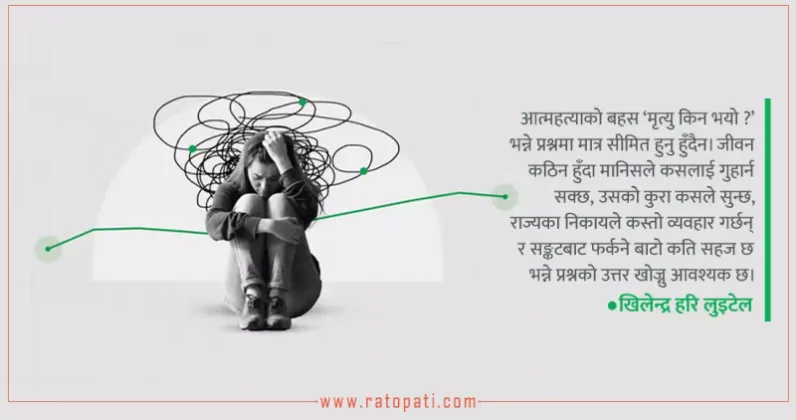
A recent opinion article published by Ratopati, in both Nepali and English, has pushed back against the common habit of describing suicide as a sudden, momentary impulse. The piece, which appears under a headline asking whether suicide stems from impulse or anger, argues that such a framing misses the reality of most cases. Instead, it describes suicide as the final expression of pain, despair, humiliation and helplessness that build up silently over a long period of time. The article further stresses that every incident carries its own causes and cannot be explained away by a single reason, urging readers to look beyond simple, one-line explanations when trying to make sense of such deaths.
Beyond the Idea of a Sudden Decision
The core of the argument is a rejection of the impulse narrative. According to the article, it is misleading to treat suicide as an act committed in a fleeting moment of anger or confusion, as though a person's life could be undone by a single passing emotion. Framing it that way, the piece suggests, flattens a deeply human tragedy into something that appears random and inexplicable.
The article instead presents suicide as an end point rather than a beginning. By the time a person takes their own life, the argument runs, they have typically been carrying a heavy internal burden for a long while. What may look sudden to outsiders is, in this view, only the visible final act of a process that unfolded gradually and often invisibly. The piece thus shifts the focus of attention away from the moment of the act and toward everything that preceded it.
This reframing matters for how such deaths are understood and discussed. If suicide is seen purely as an impulsive act, the reasoning implies, the long history of suffering behind it is overlooked, and the people around the person may fail to grasp how deep the distress had already become.
The Long Build-Up of Suffering
Rather than attributing suicide to a flash of emotion, the Ratopati article identifies a set of feelings that accumulate over time. It describes suicide as the final expression of four intertwined states:
- Pain, endured over an extended period rather than felt only in a single instance
- Despair, the sense that circumstances are unlikely to improve
- Humiliation, the wounds of shame and lowered dignity carried quietly
- Helplessness, the feeling that no available path offers relief or escape
Taken together, the article suggests, these form the emotional terrain on which the final act occurs. None of them typically appears overnight. They gather across weeks, months or years, often unnoticed by those around the person, until the accumulated weight becomes unbearable.
The piece's emphasis on accumulation carries an implicit caution. Suffering that builds slowly is easy to minimise, both by the person experiencing it and by the people close to them, precisely because it does not announce itself in a single dramatic event. By naming pain, despair, humiliation and helplessness as the underlying materials of suicide, the article invites readers to take slow-burning distress seriously rather than waiting for it to resolve on its own.
Every Case Carries Its Own Causes
The second major strand of the argument concerns explanation. The article is clear that every incident of suicide has its own causes and cannot be captured by a single reason. In other words, there is no universal formula that accounts for why a particular person, at a particular moment, reaches that final point.
This position stands against the habit of attaching one convenient cause to a death after the fact. As the piece argues, reducing a suicide to a lone trigger obscures the layered reality of the person's life and circumstances. The accumulation of pain, despair, humiliation and helplessness described in the article does not take the same shape in any two cases, which is why each incident demands to be understood on its own terms.
The argument also complicates easy blame. When a death is attributed to one identifiable reason, attention tends to settle on that single factor and on whoever or whatever is thought to be responsible for it. The article's multi-causal view resists that shortcut, pointing instead toward the fuller, more uncomfortable picture of prolonged suffering that no one line of explanation can contain.
Reaching Readers in Two Languages
Notably, the article was published by Ratopati in both Nepali and English, allowing the same argument to reach different readerships within Nepal and beyond. The Nepali version can be read on Ratopati's main portal, while the English version is available on the outlet's English site.
The bilingual presentation underscores the breadth of the article's intended audience. Questions about how suicide is understood, what drives it, and how society speaks about it are not confined to any one language community, and the decision to carry the piece in both versions reflects that.
Ultimately, the article's contribution lies in the way it reframes the conversation. By presenting suicide not as a momentary impulse but as the final expression of long-accumulated pain, despair, humiliation and helplessness, and by insisting that no single reason can explain any individual case, the piece asks readers to respond to such deaths with greater patience, humility and attention to the suffering that precedes them. Anyone struggling with feelings of overwhelming distress is encouraged to reach out to people they trust or to professional support services.