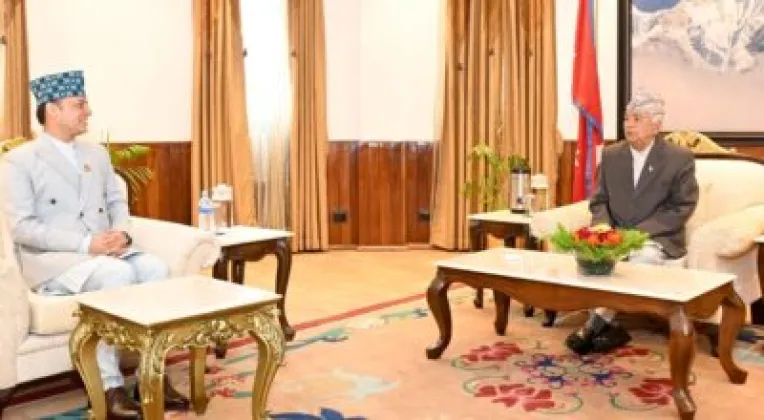
Speaker Dol Prasad Aryal called on President Ramchandra Paudel at Sheetal Niwas in Kathmandu on Friday for a meeting that centred on the summoning of the upcoming parliament session and the functioning of the Federal Parliament. The Speaker also used the occasion to brief the head of state on the Asia-Pacific Regional Conference of the Inter-Parliamentary Union (IPU) Standing Committee on Sustainable Development, an international parliamentary event that the Federal Parliament is preparing to host. The readout of the meeting was provided by the Speaker's Secretariat and reported by My Republica and Khabarhub.
Session summoning and the regular running of the House
According to the Speaker's Secretariat, the conversation between the two constitutional figures focused on the business of the legislature itself. Two themes stood out:
- the summoning of the upcoming session of parliament, and
- the operation of the House in a regular and effective manner.
That agenda is rooted in Nepal's constitutional arrangements. Sessions of the Federal Parliament are formally summoned by the President, on the recommendation of the Government of Nepal, which makes the Office of the President a necessary point of contact whenever a new session is being readied. The Speaker, who presides over the House of Representatives, the lower house of the Federal Parliament, is responsible for the day-to-day conduct of its proceedings. A discussion between the two offices ahead of a session is therefore both procedural and practical, allowing the parliamentary leadership and the head of state to be on the same page as the legislature prepares to reconvene.
The emphasis on running the House "in a regular and effective manner" is notable. A parliament that sits consistently is better placed to legislate, to scrutinise the government through questions and debates, and to take up issues of public concern in a timely way. Conversely, prolonged gaps between sittings slow the legislative pipeline and reduce opportunities for lawmakers to hold the executive to account. While the Secretariat's briefing did not specify when the new session would be summoned, the framing of the discussion pointed to a preference for continuity in parliamentary proceedings rather than a stop-start calendar.
Briefing on the IPU Asia-Pacific regional conference
The second strand of the meeting concerned the Asia-Pacific Regional Conference of the IPU Standing Committee on Sustainable Development. Speaker Aryal briefed President Paudel on the conference, which the Federal Parliament is preparing to host, the Secretariat said. While the readout did not attach dates or a venue, it confirmed that the Federal Parliament is the host institution for the event.
The Inter-Parliamentary Union is a global organisation of national parliaments that provides a forum for lawmakers to deliberate on political, economic and social questions of common concern. Its work is channelled through standing committees, of which the Committee on Sustainable Development is one, dealing with subjects such as sustainable development and the international agendas connected to it. Regional conferences held under the IPU framework bring together parliamentarians from across a geographic area, in this case the Asia-Pacific, to exchange views on those themes and to feed regional perspectives into the wider parliamentary conversation.
For Nepal, hosting a regional IPU conference places the Federal Parliament at the centre of parliamentary diplomacy in the Asia-Pacific. Such events allow the host legislature to showcase its procedures, to engage directly with visiting parliamentarians, and to shape discussion on sustainable development, an area where Nepal's experience with fragile mountain ecosystems, climate vulnerability and development challenges gives it a distinct voice. They also signal the country's continued participation in multilateral forums at a time when parliamentary exchange is increasingly seen as part of broader international engagement.
Democracy strengthened through such practices
For President Paudel, the significance of the briefing went beyond protocol. The President remarked that democracy becomes further strengthened through such practices, a comment that linked the hosting of international parliamentary events, and the regular functioning of the legislature more broadly, to the health of Nepal's democratic system. In effect, the President framed both the upcoming session and the IPU conference as evidence of a working democratic culture rather than merely items on an institutional calendar.
That framing carries particular weight given the constitutional roles of the two offices involved. The President is the head of state and holds a formal place in the parliamentary cycle through the summoning of sessions, while the Speaker is the custodian of the House's independence and order. When the two meet to discuss the convening of parliament and the country's role in international parliamentary bodies, the exchange underscores the interdependence of Nepal's constitutional institutions: the legislature cannot function in isolation, and the head of state's formal powers are most meaningful when exercised in step with an active parliament.
Friday's meeting at Sheetal Niwas, then, served two purposes at once. It kept the convening of the upcoming session on a coordinated footing between the President's office and the parliamentary leadership, and it gave the Speaker an opportunity to brief the head of state on the international conference the Federal Parliament is preparing to host. The Secretariat's readout did not include specific dates for either the new session or the conference, but the direction of the discussion was clear: a regularly functioning House, and a parliament engaged with its regional counterparts, were presented as mutually reinforcing pillars of Nepali democracy.