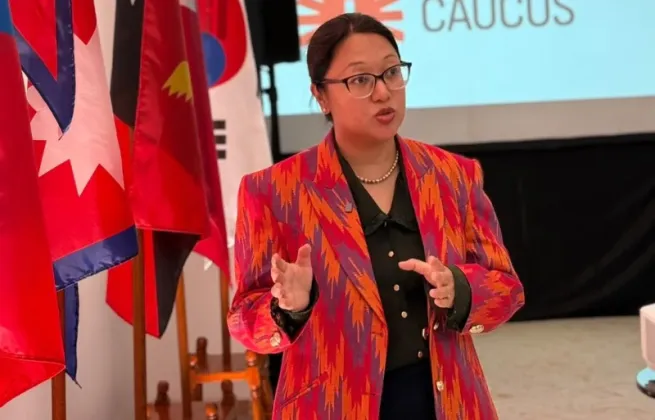
KATHMANDU - Dr. Ojaswi Sherchan, chair of the House of Representatives' Education, Health and Information Technology Committee, has called for modern technology and immediate screening to bring Nepal's hidden tuberculosis epidemic under control. She made the appeal at a meeting of the chairs of health and finance committees from across the Asia-Pacific region, held in Bali, Indonesia, from November 3 to 5. The gathering ran alongside a joint event of the Global TB Caucus and the Global Health Caucus, and Sherchan used the platform to press a twofold case: that faster, technology-driven case detection is essential at home, and that the fight against tuberculosis must be backed by adequate budget allocation.
A hidden epidemic that screening must expose
At the heart of Sherchan's message in Bali was a blunt characterization of Nepal's tuberculosis situation. The disease, she said, is not merely present in the country but is circulating as a hidden epidemic, a description that points to cases which never reach the health system, patients whose infections go undiagnosed and untreated while the bacteria continue to spread in the shadows. Against that backdrop, she argued that cutting-edge technology is needed to stop the epidemic, according to a report by Rato Pati.
Her call for immediate screening followed directly from the same reasoning. Tuberculosis that is never detected cannot be treated, and every undiagnosed case represents both a personal tragedy and a continuing risk of transmission to others. Screening, in her framing, is therefore the first and most urgent step in any serious response: find the hidden cases, and the epidemic loses the cover on which it depends. As chair of the parliamentary committee that deals with health matters, her remarks carry institutional weight beyond that of a personal appeal.
Technology featured in her comments as more than a slogan. The Rato Pati report captured her position under a headline stating that cutting-edge technology is needed to stop the hidden tuberculosis epidemic in Nepal, indicating that she placed modern tools at the centre of the response rather than at its margins. For a country that has battled tuberculosis for generations, her argument was that the same old methods cannot be expected to finish a job they have so far left incomplete, and that the response must now match the scale of what remains undetected.
Adequate budgets for tuberculosis control
Sherchan paired her technological appeal with a financial one. Adequate budget allocation for tuberculosis control, she said, must accompany any plan to modernize screening and detection. The setting made the demand pointed: she was addressing, among others, the chairs of finance committees from across the Asia-Pacific region, the very lawmakers who in their own parliaments weigh competing claims on public money. By calling for budgets in the same breath as technology, she signalled that neither measure alone would suffice. Diagnostic tools without funds to deploy them widely would stall, while funding without modern means of detection would continue to miss the hidden cases she described. Coverage by Himal Press noted that she raised these control measures during the Bali meeting.
A regional stage in Bali
The meeting itself brought together an unusually specific constituency: the chairs of health and finance committees from national legislatures across the Asia-Pacific region. Convened in Bali from November 3 to 5, it ran alongside a joint event of the Global TB Caucus and the Global Health Caucus, giving parliamentarians a dedicated space to discuss tuberculosis alongside the funding decisions that shape any response to it.
For Sherchan, the gathering offered a stage on which Nepal's experience could be placed before regional peers who share both the disease burden and the budgetary dilemmas that come with it. The format also worked in her favour as an advocate. When the people who shape health budgets sit in the same room, calls for adequate financing land with the audience best placed to act on them. Her presence at the meeting reflected the committee she leads as well, since the Education, Health and Information Technology Committee spans both health and technology portfolios, giving her a natural vantage point from which to argue that modern technology belongs at the centre of health policy.
A leading cause of premature death among men
The most sobering element of her remarks concerned mortality. Tuberculosis, Sherchan noted, is a leading cause of premature death among men in Nepal, a fact she raised as part of her case for stronger control measures. The framing of premature death matters. It speaks to lives cut short before their time, with consequences that ripple outward to the families and communities left behind.
Set against the hidden epidemic she described, the picture that emerges is of a disease exacting a quiet but heavy toll, claiming deaths that timely detection and treatment could have prevented. Sherchan returned from Bali with a message addressed as much to Kathmandu as to the regional gathering: deploy modern technology, screen immediately, and back both with adequate budget allocation. As chair of the parliamentary committee that oversees health matters, she is positioned to press that pairing in the period ahead as Nepal works to bring its hidden epidemic into the open.