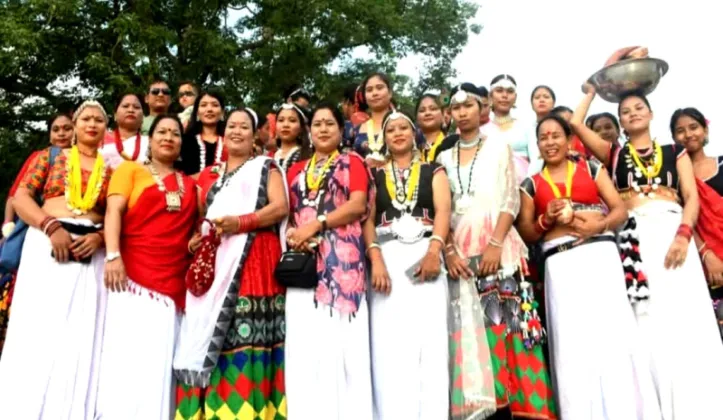
The traditional Sakhia dance has brought Dashain festivity to Tharu villages in Banke district, turning the festival season into a lively cultural celebration across settlements with dense Tharu populations. The dance begins a few days before Dashain and continues for some days after the festival ends, so the festive atmosphere builds ahead of the holiday and lingers well beyond it. Every evening, youths in most of these villages gather to perform, keeping the tradition at the heart of how the community celebrates Dashain, according to reports by Gorkhapatra, Ratopati and Khabarhub.
A dance that brackets the festival
The most distinctive feature of the Sakhia (also spelled Sakhiya) season is its timing. While Dashain itself is celebrated over a fixed span of days, the dance is not confined to the festival's official dates. It starts a few days before Dashain arrives, giving Tharu settlements an early taste of the festivities, and it continues for some days after the festival concludes, allowing the celebration to wind down gradually rather than stop abruptly.
In practice, this means the dance frames Dashain on both sides. During the festival period, the rhythm of life in Banke's Tharu settlements is set less by the calendar of the holiday itself and more by the nightly gatherings of dancers and onlookers in the village.
The period works out in three broad phases:
- Before Dashain: the dance begins a few days ahead of the festival, signalling in Tharu villages that Dashain is approaching and building anticipation among residents.
- During the festival: performances continue alongside the celebrations, weaving the dance into the heart of the festivities.
- After Dashain: the dancing goes on for some days once the festival is over, extending the holiday mood in the settlements.
An extended festive season
The result is an unusually long celebration. Where Dashain elsewhere can feel like a holiday that arrives and then passes, in these villages it unfolds as a season, opened by the first evenings of Sakhia and closed only when the dancers finally step back. The reports describe the atmosphere across the Tharu settlements as one of festivity throughout this extended period.
Youths carry the tradition
The reports highlight the role of young people in sustaining the practice. In most villages with dense Tharu populations, it is the youths who take part in the dance, turning out every evening throughout the Sakhia period.
That regularity matters. A tradition performed nightly, rather than once or twice a year, becomes part of the daily routine of the festival season. The consistent involvement of young dancers points to a practice that is still actively lived within the community, rather than one kept aside only for special occasions.
The evening gatherings also serve a social purpose. During one of the most important festivals of the year, the nightly dance brings residents of each settlement together in a shared celebration, giving the villages a common focal point every day from before Dashain until after it ends.
Dashain with a Tharu signature
Dashain is Nepal's biggest festival, observed across the country with family gatherings, religious observances and festive celebrations. In Banke's Tharu villages, the reports make clear, the festival carries a cultural marker of its own: the Sakhia dance, which converts the holiday period into a showcase of the community's traditions.
Banke, in the Tarai, is home to a substantial Tharu population, and it is in the villages where Tharu families are most concentrated that the dance takes hold most strongly each festival season. There, Dashain is experienced not only as a national holiday but as a Tharu cultural celebration, with the Sakhia dance providing its most visible expression.
The dance's reach across most villages with dense Tharu populations, as the reports describe, indicates that it remains a shared custom of the settlements rather than the preserve of a handful of communities. Its nightly performance throughout the festive window gives these villages a common cultural calendar around Dashain.
More than entertainment
What emerges from the reports is a picture of a tradition doing double duty. The Sakhia dance marks time: it announces Dashain's approach, accompanies the festival itself and extends the celebration for days after the festival has formally ended. At the same time, it organises community life during the festival, drawing villagers, and especially the young, out of their homes every evening for a collective celebration.
For Tharu settlements in Banke, the festive season therefore has a shape of its own. It begins when the dancers do, some days before Dashain, and it ends when they stop, some days after the festival. In between, the Sakhia dance gives the community's Dashain its identity, its nightly gatherings and its festivity, sustaining a cultural celebration that continues to thrive in the district's Tharu villages.
The reports on which this article is based were published by Gorkhapatra Online, Ratopati and Khabarhub.