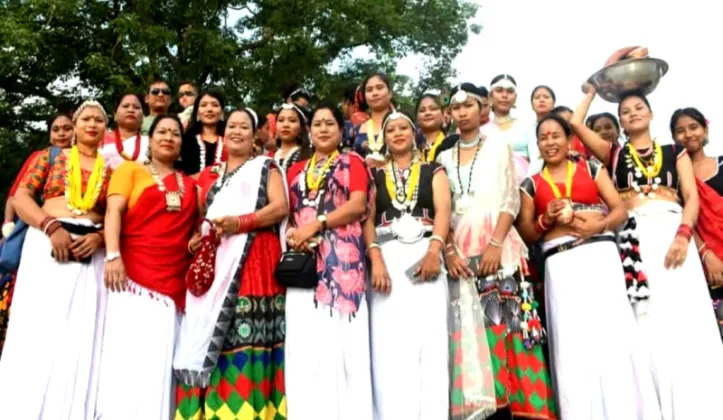
The Tharu settlements of Banke district have taken on a festive glow this Dashain season as the traditional Sakhia dance returns to the villages, transforming Nepal's biggest festival into an extended cultural celebration in the Terai plains. According to reports by Gorkhapatra, Ratopati and Khabarhub, the dance begins a few days before Dashain and continues for several days after the festival ends, creating a vibrant cultural atmosphere across villages with dense Tharu populations. Each evening, young people gather in their settlements to perform, keeping a tradition that has long defined the community's way of marking the festival season.
A festival that begins before Dashain and ends after it
What makes the Sakhia dance distinctive is its calendar. Rather than being confined to the days of Dashain itself, the tradition stretches the festive period well beyond the official holidays. Performances begin a few days before the festival arrives, building anticipation in the villages, and continue for some days after Dashain concludes, allowing the celebratory mood to linger in the settlements.
This extended schedule turns Dashain, in the Tharu villages of Banke, into a season rather than a fixed set of dates. For the duration, the settlements remain in a state of celebration, with the dance serving as the daily anchor of the festivities and the clearest sign that the festival season is under way in the community.
Evenings at the heart of the celebration
The rhythm of the festival in these villages is easy to describe:
- The dance is performed every evening throughout its run in the Tharu settlements of Banke.
- Youths in most villages with dense Tharu populations take part in the performances.
- The celebrations begin a few days before Dashain and continue for some days after the festival is over.
- The result is a continuous cultural celebration across the Tharu villages during the festival season.
The evening timing gives the dance a communal character. As dusk settles over the settlements, the performances bring villagers out of their homes and together in one place, making the dance as much a social gathering as a cultural performance.
Young dancers keep a living tradition alive
Central to the tradition, as reported, is the participation of young people. In most of Banke's villages with dense Tharu populations, it is the youths who take to the dance every evening, a fact that speaks to the continuity of the practice from one generation to the next. A tradition that depends on its youngest members for its nightly performances is one that remains visibly alive rather than preserved only in memory.
The sight of young villagers performing night after night also changes the texture of the festival for everyone around them. Dashain in much of Nepal is experienced through family gatherings, tika and blessings, and visits to elders. In these Tharu settlements, it is experienced additionally through the Sakhia dance, with the young performers providing the festival's public face and its nightly soundtrack of celebration.
For the wider community, the daily performances offer a shared experience that cuts across households. The dance creates a common space in the evenings where the settlement comes together, and it is this collective character, reported across the villages, that gives the tradition its hold on the community year after year.
Dashain through a Tharu cultural lens
Dashain is the largest and most widely observed Hindu festival in Nepal, celebrated across the country over fifteen days in the month of Ashwin with worship, family reunions, tika and the exchange of blessings. For the Tharu community, one of Nepal's oldest indigenous groups, concentrated in the Terai plains where Banke lies, the festival is celebrated through a distinct cultural vocabulary of its own.
The Sakhia dance, also rendered Sakhiya, is one of the community's signature traditions of the Dashain season in the western Terai. Its timing around the festival, beginning before Dashain and continuing after it, ties the dance inseparably to the festival period and makes it a defining feature of how the season unfolds in Tharu villages.
That distinctiveness is what the current celebrations in Banke highlight. While the festival is observed nationwide, the villages report that the Sakhia dance creates its own cultural celebration within the broader festivities, one rooted in the settlements themselves and carried by the community's own young people.
More than a performance
The reports from Banke describe a tradition that does considerable cultural work in the villages. By beginning before Dashain, the dance builds the festive atmosphere in advance; by continuing after the festival ends, it extends that atmosphere well beyond the holidays. In between, the nightly performances give the settlements a focal point around which the community gathers each evening of the season.
The continued participation of youths in most of the district's dense Tharu villages suggests that this is not a fading custom but an active, practiced one. Every evening of dancing during the festival season is, in effect, a rehearsal of the tradition by the generation that will carry it forward.
For now, the Tharu settlements of Banke present the picture the reports describe: villages in festive celebration, the Sakhia dance under way before Dashain and set to continue after it, and young dancers at the centre of it all, ensuring that when the festival season comes around again, the tradition will be there to greet it.