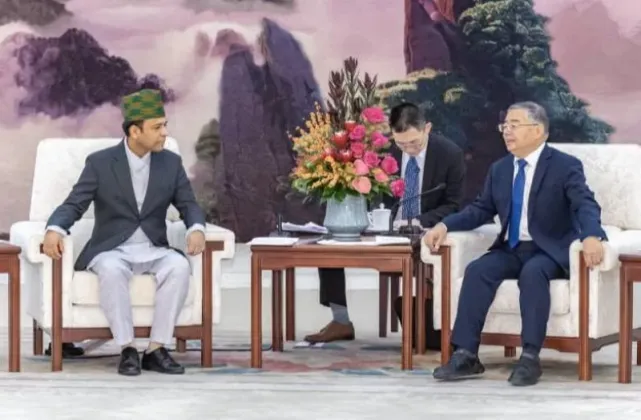
A delegation of the Rastriya Swatantra Party (RSP) has returned home after completing a nearly two-week visit to China, undertaken at the invitation of the Chinese Communist Party (CCP). The delegation, led by the party's General Secretary Bipin Acharya, arrived back in Kathmandu today, marking the formal conclusion of a trip that spanned from November 15 to November 26.
The visit, extended by one of the world's most powerful ruling parties to a prominent Nepali opposition force, had drawn attention within Nepal's political circles, where engagement between Nepali parties and the CCP has long been a recurring feature of bilateral relations between the two neighbours.
A 12-day engagement at Beijing's invitation
The RSP delegation's presence in China was at the explicit invitation of the Chinese Communist Party, the governing party of the People's Republic of China. Such invitations to Nepali political parties are part of a broader pattern of party-to-party diplomacy that Beijing has cultivated across South Asia, using direct engagement with political leaderships to strengthen ties beyond formal state-to-state channels.
Led by General Secretary Bipin Acharya, the team spent twelve days in the country, from November 15 to 26. The duration of the visit suggested a fairly extensive programme, typical of the structured itineraries that the CCP generally arranges for visiting foreign delegations, which commonly combine political meetings, briefings and exposure visits.
The delegation's return to Kathmandu today brought the visit to a close, with the party now expected to reflect on and share the outcomes of its engagements with the broader party structure and the public.
The RSP's growing footprint in national politics
The Rastriya Swatantra Party, often referred to by its acronym RSP, has emerged as one of the most talked-about political forces in Nepal in recent years. Founded by people who rose to prominence through anti-corruption activism and calls for systemic reform, the party has positioned itself as an alternative to Nepal's traditional political establishment. Its rapid rise in the last federal parliamentary elections, where it secured a significant bloc of seats in the House of Representatives despite being a new entrant, transformed it into a key player in national politics.
Given that stature, the party's engagement with a foreign power of China's weight carries political significance at home. Nepali political parties across the spectrum have historically maintained channels of communication with the CCP, and visits like the RSP's are closely watched for what they may signal about the party's foreign policy orientation and its approach to Nepal's relations with its northern neighbour.
The invitation to the RSP, in particular, highlighted the interest the Chinese Communist Party has shown in reaching out to Nepal's newer political forces, alongside its long-established relationships with the country's older, established parties.
Return to Kathmandu and what lies ahead
The delegation's return today formally wrapped up the November 15-26 programme. The party has not yet laid out publicly, in the materials available, the full detail of its engagements or the specific outcomes of the discussions held during the trip.
What is clear, however, is that the visit represented a notable moment for the party: a first-of-its-kind high-level exposure to China's ruling party at a time when the RSP continues to consolidate its organisational base and define its positions on national and foreign policy matters.
Back home, the party's supporters and observers of Nepali politics alike will be watching closely for how the leadership interprets and communicates the lessons and impressions gathered during the twelve-day visit, and whether the engagement translates into a more defined RSP approach on issues concerning Nepal-China relations.
Party-to-party diplomacy and Nepal's balancing act
Nepal sits between two giant neighbours, India and China, and its political parties have long practised a careful diplomacy of maintaining workable relations with both. Party-to-party exchanges with the CCP have become a regular element of this balancing act, with delegations from various Nepali parties travelling to China over the years and Chinese officials and party representatives reciprocating visits to Kathmandu.
For a party like the RSP, which has built its identity around domestic governance reform, transparency and accountability, engagement with foreign ruling parties also offers an opportunity to demonstrate that it can conduct itself as a credible actor on the international stage, not merely as a domestic protest movement.
The return of the Bipin Acharya-led delegation today therefore closes one chapter while opening another: the task of translating diplomatic exposure into political positioning. How the party frames the visit in the days ahead, and how it responds to questions about its engagement with Beijing, will likely shape the next round of public discussion around the RSP's place in Nepal's evolving political and diplomatic landscape.
For now, the immediate news is straightforward: the delegation is home, the visit is complete, and Nepal's newest major political party has added an international engagement of considerable symbolic weight to its short but eventful history.