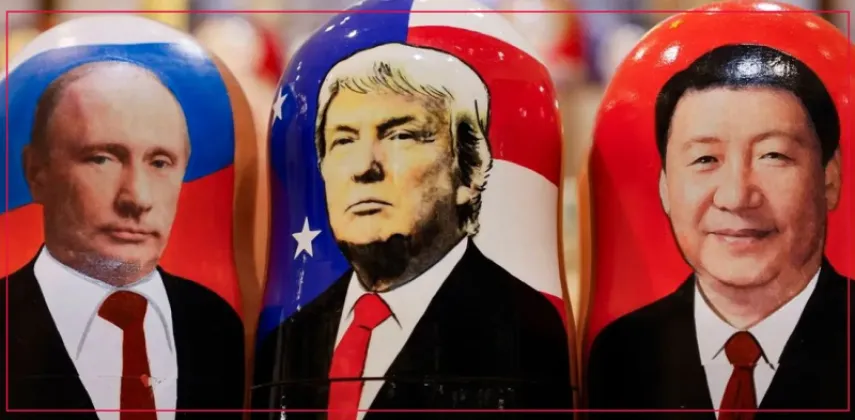
Russian President Vladimir Putin has proposed a trilateral summit with US President Donald Trump and Chinese President Xi Jinping next month to discuss ending the war in Ukraine, according to a report by The Wall Street Journal. The idea was raised during an October 9 telephone call between Putin and Trump, and Kremlin spokesman Dmitry Peskov has since confirmed that discussions about the possible meeting are underway. The prospective talks could coincide with the APEC summit in China, a timing that has added weight to the proposal. It has also drawn criticism, because Ukraine and Washington's European allies would likely not be represented, even though the future of the war in Ukraine would be the central subject on the table.
A Proposal Born on a Phone Call
According to The Wall Street Journal, Putin floated the proposal during his October 9 call with Trump, suggesting that the three leaders meet as early as next month to discuss ways of ending the fighting in Ukraine. The report has been picked up widely, including by Nepali outlets such as Ratopati, Nagarik News and Khabarhub.
Peskov's confirmation that discussions are underway signals that the Kremlin is treating the idea as a live diplomatic track rather than a passing remark, although no date, venue or final agreement on the format has been announced.
The known elements of the proposal so far are limited but striking:
- Participants: Putin, Trump and Xi, in a trilateral format with no other leaders announced.
- Timing: as early as next month, possibly coinciding with the APEC summit in China.
- Agenda: ending the war in Ukraine, with Trump also indicating that denuclearisation could feature in the discussions.
- Status: under active discussion, according to the Kremlin, but not yet confirmed.
Why the Format Matters
A meeting of this kind would bring the leaders of the United States, Russia and China into direct talks on a single stage, a configuration that would be watched closely around the world given the weight each leader carries. The fact that the proposal came directly from Putin, and was raised one-on-one with Trump before any public announcement, underlines the direct channel between Moscow and Washington. Whether that channel can produce progress on ending the war, however, depends heavily on who else is involved, and it is on this point that the proposal has run into immediate controversy.
Criticism Over Who Is Missing from the Table
The sharpest reaction to the proposal concerns who would not be present. According to the reports, Ukraine and Washington's European allies would likely not be represented at the proposed summit, even though its stated purpose is to end a war being fought on Ukrainian territory. That prospect has drawn criticism because decisions about Ukraine's future made without Ukrainian participation would raise fundamental questions about whether Kyiv would accept, or even recognise, any outcome that emerges.
The likely exclusion of European allies compounds the concern. European governments have been closely involved in supporting Ukraine, and a settlement negotiated purely among Washington, Moscow and Beijing would leave them on the sidelines of decisions that affect the security of their own continent. Critics of the trilateral format argue that any deal reached in such a setting could prove fragile precisely because the parties most affected by it would have had no voice in the room.
Trump's Position: Ready to Meet, Critical of Zelenskyy
For his part, Trump has said he is ready to meet Putin and Xi in China, indicating that denuclearisation and the Ukraine war could both be discussed if the meeting goes ahead. Folding denuclearisation into the agenda alongside the war would considerably widen the scope of any summit, turning it from a negotiation about a single conflict into a broader conversation between three nuclear-armed powers.
At the same time, Trump has directed sharp criticism at Ukrainian President Volodymyr Zelenskyy, comments that will do little to reassure Kyiv as plans for a meeting about its own future take shape. With Ukraine likely excluded from the table and the US president openly critical of its leader, the political ground around the proposed summit is already contested before a single seat has been arranged.
APEC Timing and the Road Ahead
The possible overlap with the APEC summit in China provides a natural window for the meeting, since the forum brings together leaders from across the region and could allow a trilateral gathering to be arranged on its margins.
Much remains unresolved. Neither the Kremlin nor the White House has announced a date or venue, and Peskov has gone only so far as to confirm that discussions are underway. The open questions are likely to shape the debate in the coming weeks:
- Whether the summit is confirmed at all, and if so, when and where it would be held.
- Whether Ukraine, President Volodymyr Zelenskyy, or European allies will be given any role in or around the talks.
- Whether the agenda expands beyond the war in Ukraine to include denuclearisation, as Trump has suggested.
For now, the proposal stands as a signal of intent from Moscow and an expression of willingness from Washington, with Beijing's role at the centre of the arrangement. As the reports make clear, the idea has moved from a private phone call to an openly discussed possibility in a matter of days. The coming weeks will show whether the three leaders do indeed sit down together, and whether a summit about Ukraine's future can carry weight while Ukraine itself looks on from the outside.