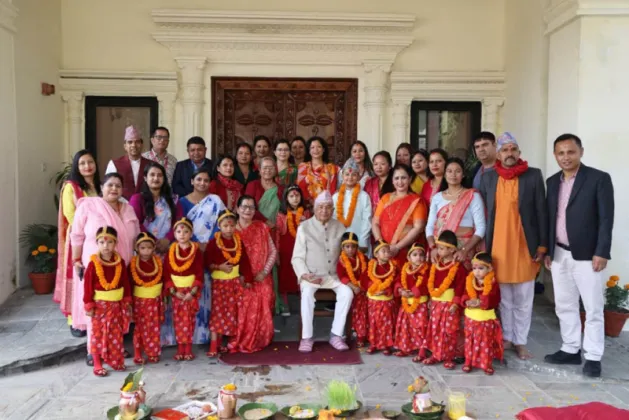
President Ram Chandra Paudel performed the traditional worship of nine young girls, known as Navakanya puja, at the President's Office, Shital Niwas, in Kathmandu on Tuesday, on the occasion of Bada Dashain 2083. First Lady Sabita Paudel accompanied the head of state in the ritual, in which nine girls are venerated as manifestations of the nine forms of Durga Bhagawati during the Navaratri festival. The President also offered gifts to the girls, following a custom that has been passed down for generations. The ceremony at the country's highest public office, reported by Nepal Press, Ratopati and Khabarhub, offered a public glimpse of how the rites of the Dashain season continue to be observed at the very summit of Nepal's constitutional order.
Nine girls, nine forms of the goddess
At the heart of Tuesday's ceremony lay one of the most distinctive observances of the Hindu religious calendar. In the Navakanya tradition, nine young girls are worshipped together, with each girl understood to embody one of the nine forms of Durga Bhagawati that devotees honour across the nine nights of Navaratri. These forms are traditionally enumerated as:
- Shailaputri
- Brahmacharini
- Chandraghanta
- Kushmanda
- Skandamata
- Katyayani
- Kalaratri
- Mahagauri
- Siddhidatri
Under the prescribed practice, the girls are welcomed with ceremony, seated with respect and presented with offerings, including gifts, as living guests of the goddess herself. President Paudel offered gifts to the nine girls in keeping with this rite. The participation of First Lady Sabita Paudel lent the occasion a distinctly domestic character, echoing the way Navakanya worship is carried out in households across Nepal during the festival period, as well as in temples and public institutions.
Continuity of a long-standing Sanatani tradition
The puja at Shital Niwas was performed, as the reports noted, in keeping with a long-standing Sanatani tradition. Sanatana Dharma, the term by which many Hindus describe their faith, conveys the idea of an eternal way of life, and its festivals are marked by rituals whose outlines have remained remarkably stable over centuries. The worship of young girls as embodiments of the goddess reflects a central belief of this tradition: that the divine feminine, or shakti, is present in living form and deserves to be honoured as such.
For the office of the President, an institution that stands above the day-to-day contest of politics, personally conducting the ritual carries its own symbolic weight. The image of the head of state, joined by the First Lady, performing a household rite of the Dashain season illustrates how religious observance and public office continue to intersect in Nepal, where the festival remains the most widely celebrated occasion in the national calendar.
Dashain 2083 and the rhythm of the festival
Bada Dashain, the grandest festival in the Nepali calendar, commemorates the victory of goddess Durga over the demon Mahishasura, a story that has come to stand for the triumph of good over evil. The festival opens with Ghatasthapana, when the goddess is invoked and barley seeds are sown to produce the golden jamara that devotees later receive along with tika and blessings, and unfolds through nine nights of Navaratri worship before culminating in the celebrations of Vijaya Dashami.
The Navakanya worship performed by President Paudel on Tuesday sits within this arc of observance, binding the devotion of Navaratri to the festive days of Bada Dashain 2083. Similar rites are performed each year in homes, temples and institutions across the country, and the ceremony at the President's Office mirrors in public form what countless Nepali families carry out privately: the welcoming of the goddess in the guise of her youngest devotees.
The offering of gifts to the nine girls, the detail highlighted in the reports from Shital Niwas, is central to the meaning of the rite. Honoured, fed and presented with presents, the girls are treated not merely as participants but as the goddess herself received as a guest, a gesture that devotees believe invites the blessings of Durga Bhagawati upon the household, the institution and, in the case of the head of state, the nation.
As the reports of Tuesday's ceremony make clear, the observance at Shital Niwas required no elaborate spectacle to convey its significance. The President's worship of the Navakanya, performed alongside the First Lady and in accordance with the Sanatani tradition, stood as a quiet affirmation that the rituals of Dashain, observed in the same form for generations, remain a living part of Nepal's public and private life alike.