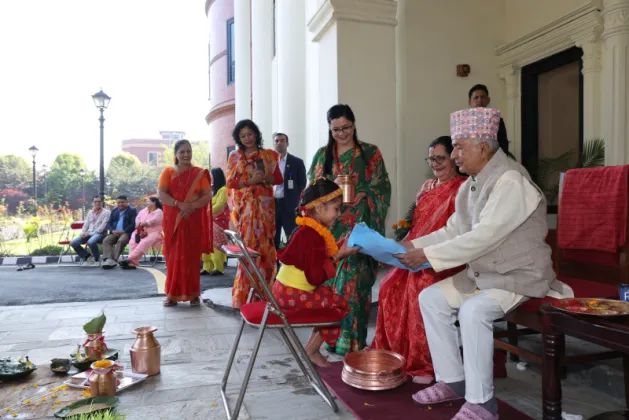
President Ram Chandra Paudel performed the traditional Navakanya worship at Shital Niwas, the official residence of the President of Nepal, on October 20, 2026, as part of the observance of the Dashain festival. The ceremony, held at the presidential residence in Kathmandu, centered on the veneration of nine young girls, who are worshipped as living manifestations of goddess Durga. The ritual is regarded as one of the most spiritually significant observances of Dashain, Nepal's largest and most widely celebrated Hindu festival. The ceremony at the presidential residence was reported by Nepal Lead and Thahakhabar.
The Navakanya Tradition: Honoring the Goddess in Human Form
The Navakanya worship occupies a central place in the religious life of Dashain. In this ritual, nine young girls are consecrated and worshipped as embodiments of goddess Durga, the powerful mother deity who symbolizes strength, protection and the triumph of good over evil. The practice reflects the broader Hindu tradition of kanya puja, in which young girls are treated as living forms of the divine and honored with reverence, offerings and blessings.
In Hindu belief, goddess Durga is revered in her nine principal manifestations, collectively known as the Navadurga:
- Shailaputri
- Brahmacharini
- Chandraghanta
- Kushmanda
- Skandamata
- Katyayani
- Kalaratri
- Mahagauri
- Siddhidatri
Each of the nine girls honored in the ceremony is understood to symbolize these divine forms. Rituals of this nature are customarily performed during the middle days of the Dashain festival, when the worship of the goddess reaches its peak. Such observances traditionally involve the ceremonial welcome of the girls, the application of tika, the offering of flowers and other sacred items, and acts of hospitality carried out in their honor. For devotees, the worship of the Navakanya is believed to invoke the blessings of the goddess herself, bringing prosperity, wellbeing and protection to families and communities.
A Practice Deeply Rooted in Nepali Culture
Nepal's association with the worship of young girls as goddesses runs especially deep. The country is home to the centuries-old Kumari tradition, in which a young girl from the Newar community of the Kathmandu Valley is venerated as the living goddess. The Navakanya worship performed during Dashain draws on the same spiritual idea, that divinity can manifest in the pure form of a child. The ritual thus connects the household devotions of ordinary families with practices preserved and performed at the very highest levels of the state.
Dashain: The Festival of Divine Victory
Dashain is the longest and most important festival in the Nepali calendar, observed over fifteen days beginning with Ghatasthapana, the ritual sowing of barley seeds known as jamara. The festival commemorates the victory of goddess Durga over the demon Mahishasura, a triumph celebrated as the victory of truth and righteousness over evil. Throughout the festival, devotees observe fasts, offer prayers and perform special pujas in honor of the goddess.
The festival reaches its emotional and spiritual culmination in the days when elders apply tika and jamara on the foreheads of younger family members and bestow blessings for their health and fortune. Homes across the country are cleaned and decorated, family members travel to their ancestral villages and towns, and markets fill with festival shoppers. Against this backdrop of nationwide celebration, the Navakanya worship at Shital Niwas formed part of the religious observances marking the festival at the highest office of the state.
Tradition Observed at the Seat of the Presidency
Shital Niwas serves as the official residence and workplace of the President of Nepal, and the performance of the Navakanya worship there highlighted the continuity of the country's religious and cultural traditions within the institution of the head of state. President Ram Chandra Paudel, who has held the country's highest office since March 2023, took part in the ritual as part of the festival observances at the presidential residence.
The ceremony carries symbolic weight beyond its religious significance. In a country where a majority of the population follows Hinduism, and where Dashain transcends religious boundaries to become a shared national celebration, the participation of the head of state in the festival's sacred rituals reflects the enduring bond between Nepal's cultural heritage and its public institutions. Observances of this kind at Shital Niwas connect the modern presidency with customs that have been passed down through generations.
For devotees and observers alike, the worship of the nine girls as manifestations of goddess Durga offered a moment of deep spiritual resonance during one of the most auspicious periods of the year. As reported by Nepal Lead and Thahakhabar, the ritual reaffirmed a living tradition that continues to define Nepal's cultural identity, even as it is practiced within the official residence of the republic's head of state.