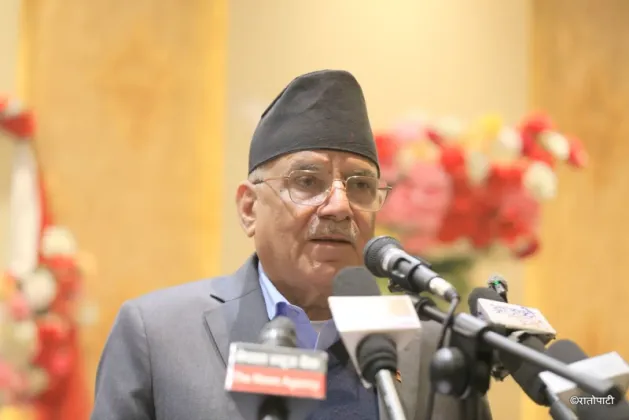
Nepali Communist Party coordinator and former prime minister Pushpa Kamal Dahal 'Prachanda' said on Tuesday that local-level elections cannot produce the kind of electoral wave witnessed in federal elections. Speaking at a training programme held in Tanahun district as part of the party's awakening campaign, Prachanda argued that the sweeping victory seen in a House of Representatives election is simply not possible at the local level.
The former prime minister's remarks were reported by multiple Nepali news outlets on Tuesday, November 24, 2026, including Rato Pati and Thaha Khabar, both of which covered his address to party cadres gathered in the hill district of Gandaki Province.
A distinction between two electoral arenas
Prachanda's central argument was that local elections and federal elections operate on fundamentally different political dynamics. According to the reports, he told the training gathering that the wave which can carry a party to a sweeping result in a House of Representatives election cannot be replicated in local polls.
His comments come as the Nepali Communist Party, which he coordinates, has been organising an awakening campaign across the country, with training programmes aimed at preparing its cadres and leaders for upcoming political contests. The Tanahun session was one such event under that campaign, and Prachanda used the platform to outline his reading of the electoral landscape ahead.
Context of the remarks
Prachanda, who has served as prime minister multiple times and remains one of Nepal's most influential political figures, has long been known for closely analysing electoral trends within his party. His assessment that local polls resist federal-style waves reflects the widely observed pattern in Nepali politics, where national-level momentum and local-level outcomes have often diverged, with local issues, candidates and grassroots networks playing a decisive role in ward, municipal and district contests.
The setting of the remarks is also notable. Tanahun, a district with a mixed political tradition, has been part of the party's grassroots outreach, and the awakening campaign under which the training was held appears to be the Nepali Communist Party's vehicle for re-energising its organisational base. By addressing party members directly at such trainings, Prachanda has been signalling the importance his party places on ground-level preparation rather than relying on national sentiment alone.
What the remarks suggest for the party's strategy
While the reports of his speech focused on his electoral assessment, the message carries clear organisational implications. By telling cadres that a federal-style sweep is not possible locally, Prachanda appeared to be tempering expectations and emphasising the need for hard organisational work at the municipal and ward levels, where individual candidates and local performance tend to matter more than national narratives.
The remarks were picked up by Nepali media on the same day, with Rato Pati reporting his line that "a storm like the federal election is not possible at the local level," and Thaha Khabar similarly carrying his comments from the Tanahun training programme.
Looking ahead
As Nepal's political parties continue their preparations for future polls at various tiers, Prachanda's assessment in Tanahun offers an early indication of how the Nepali Communist Party intends to approach the local electoral battleground: not by banking on a national wave, but through cadre training, grassroots mobilisation and attention to local dynamics. The awakening campaign, under which Tuesday's programme was organised, is expected to continue as the party seeks to consolidate its position across the country.
For now, the former prime minister's message to his party in Tanahun was unambiguous: victory at the local level must be earned locally, and no amount of federal-level momentum can substitute for groundwork on the ground.