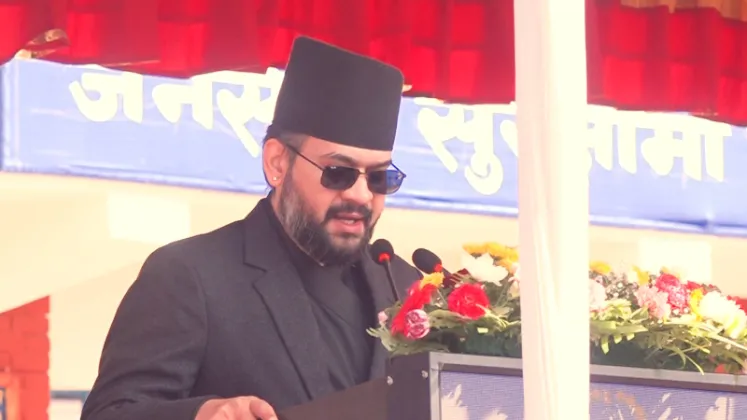
Prime Minister Shah extended Vijaya Dashami greetings to the people of Nepal on the occasion of the festival, observed this year on October 21, 2026, and used his message to deliver a pointed call for national unity against corruption and misrule. In his greetings, the Prime Minister stressed that ending corruption and bad governance is not the responsibility of any single institution or individual alone, but a collective effort that demands the participation of citizens across the country. The message, issued on one of the most important days of the Nepali cultural calendar, combined the warmth of festival greetings with a serious reminder about the values of clean governance and public accountability.
A Festival Message with a Governance Focus
The Prime Minister's Vijaya Dashami message was carried by Nepal Views and Nepal Lead, both of which highlighted the anti-corruption theme at the heart of his greetings.
In the message, Prime Minister Shah extended his best wishes to the Nepali people on the occasion and turned to the question of governance. He stressed that corruption and misgovernance can be brought to an end only through collective effort, underlining that the fight against these problems cannot succeed if it is left to a few hands.
The key points of the message can be summarized as follows:
- Festival greetings: The Prime Minister extended Vijaya Dashami greetings to the people on the occasion of the festival, which fell on October 21, 2026.
- Call for unity: He urged the people to stand united against corruption and misrule.
- Collective effort: He emphasized that ending corruption and bad governance requires the combined effort of all.
Festival occasions in Nepal have long been moments when the country's top leadership addresses the nation, and Vijaya Dashami is among the most prominent of these occasions. This year, the Prime Minister chose to pair his congratulations with a message of civic responsibility, drawing a direct line between the spirit of the festival and the need for honesty in public life.
Unity Against Corruption and Misrule
The central theme of the message was the idea that corruption and misgovernance are challenges too large for any one person or office to solve. In framing the issue this way, the Prime Minister placed responsibility not only on the machinery of the state but also on the wider public, calling on citizens to unite in the effort to end corruption and bad governance.
The phrase collective effort stood out as the key idea of the message. Rather than presenting the fight against graft as the government's burden alone, the Prime Minister described it as a shared national task in which every citizen has a role. His reference to misrule similarly pointed beyond individual acts of corruption to the broader quality of governance, tying the two concerns together in a single call for collective action.
The choice of Vijaya Dashami for such an appeal also carries weight. Dashain, at its core, celebrates the victory of good over evil, and the Prime Minister's message echoed that symbolism by placing the fight against corruption within the language of a shared national endeavor undertaken at a moment when the entire country comes together.
The Significance of Vijaya Dashami
Vijaya Dashami is the most important day of Dashain, the largest and longest festival in Nepal. Celebrated by Hindus across the country as well as by Nepali communities around the world, the festival commemorates the victory of the goddess Durga over the demon Mahishasura, a triumph of good over evil that gives the occasion its enduring meaning.
Tika, Jamara and Family Reunions
The heart of Vijaya Dashami lies in the giving of tika and jamara. On this day, elders apply a mixture of rice, vermilion and yogurt on the foreheads of their younger relatives, place sprigs of jamara, the yellow barley shoots grown during the festival days, and offer blessings for long life, health and prosperity. The exchanges continue over the following days as families travel between households to receive tika from their elders.
Dashain is also the season of homecomings. People working far from their home towns and villages return to celebrate with their families, offices and schools close for the holidays, and markets fill with shoppers preparing for the festivities. For many Nepalis, the festival is as much about family reunion and renewal as it is about ritual.
A Custom of Festival Messages
Against this backdrop, the tradition of leaders issuing greetings on major festivals is a familiar feature of public life in Nepal. Festivals such as Dashain, when the whole country comes together in celebration, offer the nation's leadership a regular moment to address citizens directly, and messages from the head of government are a central part of that custom.
In this year's message, Prime Minister Shah used that moment to look beyond congratulation. By coupling his Vijaya Dashami greetings with a call to unite against corruption and misrule, he connected the festival's spirit of togetherness with the everyday work of building cleaner and more accountable governance. His message, in essence, asked that the unity on display in family gatherings across the country during Dashain be carried forward into the shared effort to end corruption and bad governance.
As families across Nepal continue their Dashain celebrations, the Prime Minister's words stand as this year's reminder that the festival's theme of the victory of good over evil extends, in his view, to the conduct of public life itself.