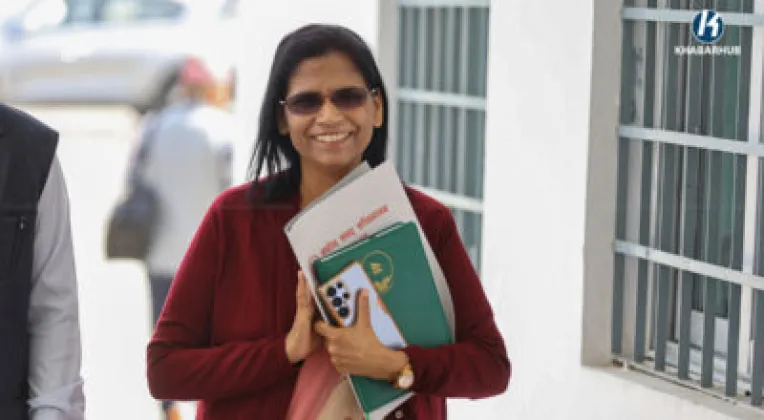
KATHMANDU - CPN (UML) parliamentary deputy leader Padma Aryal on Thursday accused the government of an extreme misuse of power in the Inam Sapkota mobile phone case, questioning how a mobile phone belonging to a person under police investigation could remain for two days at the private residence of the Prime Minister's adviser. Speaking to journalists in Kathmandu, Aryal said the episode had raised suspicions of evidence tampering and had drawn a government that came to power on the slogan of good governance into serious legal and moral questions.
A Phone, Two Days and an Adviser's Residence
At the centre of Aryal's criticism is the handling of the mobile phone of Inam Sapkota, a person currently under police investigation. According to the UML leader, that phone remained for two full days at the private residence of an adviser to the Prime Minister, an arrangement she described as deeply troubling for an ongoing police inquiry.
Aryal told reporters that it was a serious matter for property linked to an active investigation to be held at a private home connected to the very top of the government. In her assessment, that fact alone is enough to give rise to the suspicion that evidence in the case could have been tampered with, a concern that goes directly to the credibility of the investigation itself.
She framed the episode not as an administrative lapse but as an abuse of state authority, arguing that the government had allowed an item connected to a police investigation to sit for two days at the residence of the Prime Minister's own adviser. Summarising her position, the key points of her accusation were:
- The mobile phone of a person under police investigation remained for two days at the private residence of the Prime Minister's adviser.
- Aryal said this raises suspicions of evidence tampering in the case.
- She characterised the episode as an extreme misuse of power by the government.
Standard Practice and the Tampering Suspicion
Aryal's criticism rests on the expectation that items connected to a police investigation remain within the custody of investigators, with their handling properly accounted for at every stage. In her view, the fact that the Sapkota phone spent two days at the adviser's private residence, rather than remaining with the police, was itself sufficient grounds for the suspicion that evidence could have been compromised.
She argued that the longer such questions remain unaddressed, the greater the damage to public confidence in the fairness of the process. For a government that presented itself to voters as a break from the past, she suggested, the appearance of proximity between an active investigation and the Prime Minister's own advisory circle is precisely the kind of situation it had promised to prevent.
Legal and Moral Questions for a Good Governance Government
For Aryal, the significance of the case extends beyond the handling of a single piece of evidence. She said the government, which came to power with the slogan of good governance, has itself now fallen into legal and moral questions. In other words, an administration elected on promises of clean and accountable rule now finds its own conduct under scrutiny in a matter involving the police.
She pointed to the gap between the government's founding rhetoric and its conduct in the Sapkota case, insisting that the promises made to the public cannot coexist with the misuse of power she alleges. Her message to the government was that it cannot escape accountability by invoking the mandate it received, because the standards it set for itself are the standards by which it is now being judged.
As parliamentary deputy leader of the CPN (UML), Aryal is a senior voice in parliament, and her remarks reflect the opposition's decision to turn the Sapkota mobile phone case into a direct challenge to the government's credibility on governance and the rule of law.
A Sarcastic Message to the RSP
Alongside her allegations in the Sapkota case, Aryal also delivered a sarcastic jibe aimed at the Rastriya Swatantra Party (RSP). As Nepal Press reported, she remarked that it was not too late to say that this government was one of the UML and the Congress.
The barb underscored her broader argument that the government has failed to live up to the principles on which it sought public support, and that its conduct in office now invites comparisons with the very political forces it once distinguished itself from. Coming in the same breath as her accusations in the Sapkota case, the remark signalled that her criticism was directed not only at the handling of evidence but at the character of the government as a whole.
Political Stakes in the Sapkota Case
The Inam Sapkota mobile phone case has now moved from a police matter to a full political confrontation between the government and the opposition. Aryal's central claim, that an item of evidence in an active investigation was left for two days at the private residence of the Prime Minister's adviser, places the chain of custody of that evidence and the conduct of officials close to the Prime Minister squarely in question.
By framing the case as one of extreme misuse of power, she has sought to make it a test of the government's good governance commitments. Until the questions she raised about the phone's whereabouts and the possibility of evidence tampering are answered, she indicated, the government will continue to face both legal and moral scrutiny over its role in the episode.