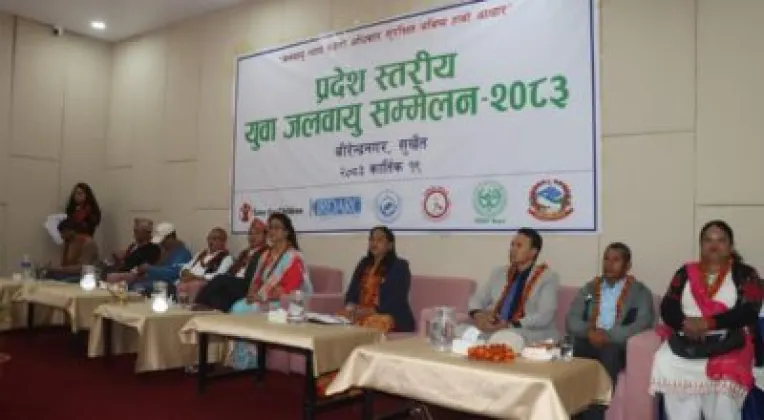
Karnali Province government spokesperson and Minister for Industry, Tourism, Forest and Environment Kalyani Khadka said the provincial-level Youth Climate Conference must serve as a foundation for disaster risk reduction. She made the remarks at the conference coordinated by her ministry, with financial support from Save the Children and participation from youth and rural organisations, including KIRDAC Nepal and Panchtara Youth Protection Forum Jajarkot.
Climate conference linked to disaster risk reduction
Khadka’s message placed disaster risk reduction at the centre of the conference’s purpose. Her remarks called for the gathering to provide a basis for work on reducing disaster risks, rather than being treated only as a one-time event. The statement connected the conference’s focus on climate issues with the need to address disaster risk in Karnali Province.
The conference was coordinated by the Karnali Province Ministry of Industry, Tourism, Forest and Environment. Khadka’s role as both the province’s government spokesperson and the minister responsible for the ministry’s portfolio gave her remarks a place in the provincial government’s engagement with the event. The central message she delivered was that the conference should underpin disaster risk reduction.
The event brought together organisations from beyond the provincial ministry. Save the Children provided financial support, while the Karnali Integrated Rural Development and Research Centre (KIRDAC) Nepal, Panchtara Youth Protection Forum Jajarkot and rural organisations participated. The available information identifies these groups as participants and supporters; it does not specify the conference’s full programme or the individual contributions made by each organisation.
Role of youth and participating organisations
The gathering’s provincial-level designation and youth focus placed young people at the heart of the event. Khadka’s call set an expectation that the conference should have a practical connection to disaster risk reduction. The statement did not detail particular measures, projects or commitments adopted at the conference, but it underscored the importance she attached to linking its discussions with that broader objective.
The mix of a provincial government ministry, a financial supporter, research and development organisations, a youth protection forum and rural organisations reflects the range of participants named in the event summary. Their involvement provides the institutional setting for Khadka’s remarks. The conference was ministry-coordinated, while support and participation came from the organisations identified above.
The call also gives the conference a role beyond convening participants: it is expected to serve as a foundation for disaster risk reduction. Khadka’s remarks therefore focused on how the event should underpin that work, rather than announcing a specific programme or a new policy. No further details were provided about follow-up arrangements, timelines or planned activities.
A stated direction for the conference
For the provincial government, Khadka’s statement sets out the purpose she wants the Youth Climate Conference to serve. Its stated direction is to connect the conference with disaster risk reduction, with young people and participating organisations part of the gathering. The conference was coordinated by the Ministry of Industry, Tourism, Forest and Environment and supported financially by Save the Children.
The event’s significance, as presented in Khadka’s remarks, lies in making disaster risk reduction a foundation for the conference’s work. The available information does not report specific outcomes or decisions from the gathering. It does, however, establish the minister’s central message: the youth climate conference should provide a basis for disaster risk reduction in Karnali Province.