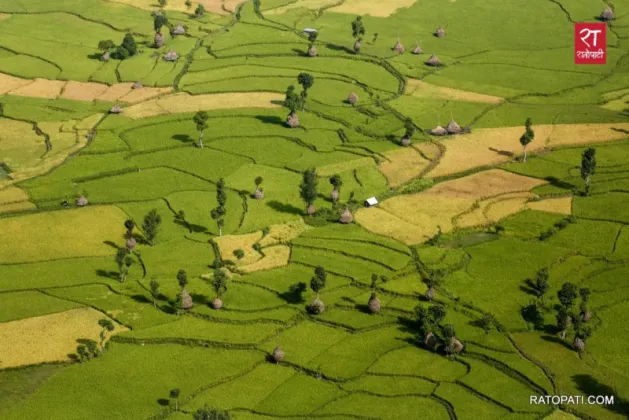
The paddy fields along the banks of the Tamakoshi River in Ramechhap district have ripened and turned a deep golden colour, signalling that the harvest season has arrived in the river valley. With Dashain just around the corner, farmers in the settlements lining the river are busy cutting, drying and bringing in the crop, racing to gather the grain before the festivities begin. According to a photo feature published by RatoPati, the ripening paddy around the Pahelpur area has added to the natural beauty of the rural fields, transforming the valley into a sweeping canvas of gold at precisely the time of year when households need the harvest most.
Golden fields herald the harvest season
The change in colour across the paddy plots is the clearest sign that the crop is ready. Over recent weeks, the green that dominated the Tamakoshi valley through the monsoon has given way to gold as the grain matures in the autumn sun. For farming families, the sight is both beautiful and urgent: it means the months of planting, weeding and waiting are about to pay off.
Harvest work along the river follows a familiar rhythm, and the activities now under way include:
- Cutting the ripe stalks, usually with sickles, and laying them in sheaves across the fields
- Spreading the harvested paddy on open ground to dry in the clear autumn weather
- Threshing and winnowing to separate grain from straw
- Carrying the grain home for storage ahead of the festival period
The dry, sunny days that follow the monsoon are well suited to this work, allowing farmers to dry and process the crop quickly once it is cut.
Racing the festival clock
Dashain, the biggest festival in the Nepali calendar, falls at this time of year, and its approach shapes the pace of life in villages across the country. Houses are cleaned and decorated, family members living in cities or abroad begin their journeys home, and preparations for days of feasting and celebration gather momentum. For farming households along the Tamakoshi, a harvest that is complete before Dashain carries particular weight. Bringing the new grain home in time means the festival can be celebrated from a position of security, with the year's principal crop safely stored and food for the festive season assured.
That is why the days leading up to Dashain are among the busiest of the farming year. Rather than pausing for the approaching festivities, farmers are extending their working days, moving between the riverside fields and their homes as they cut, dry and transport the paddy. The urgency is visible across the valley, where fields that stood full only days ago are being emptied sheaf by sheaf.
A lifeline along the Tamakoshi
Ramechhap is a hilly district in Bagmati Province where flat, easily cultivated land is limited. Much of its farming takes place on terraced slopes, and the valleys carved by the Tamakoshi River hold some of the most productive fields available to local farmers. Land along the river benefits from access to water and gentler terrain, making these banks prized for paddy cultivation.
Paddy remains Nepal's staple crop and the backbone of rural livelihoods across much of the country. Planted with the arrival of the monsoon in the Nepali month of Asar, the crop matures through the rainy season and ripens in autumn, with the main harvest falling in and around the months of Aswin and Kartik. That timing places the harvest directly alongside Dashain, linking the festival and the fields in the rhythm of rural life. A successful harvest along the Tamakoshi therefore does more than fill granaries: it underpins household food supplies for the year ahead and anchors the economy of the villages along the river.
A landscape of abundance
For now, the golden fields along the Tamakoshi offer a picture of rural Nepal at its most characteristic, where the demands of the harvest and the approach of the country's largest festival arrive together. As RatoPati's photo feature shows, the ripening crop has done more than signal the start of harvest work; it has added to the natural beauty of the rural landscape, drawing the eye across the valley as the grain waits to be gathered.
In the coming days, as sheaves are carried home and the fields are cleared, the valley will complete its annual transition from standing crop to stored grain. By the time Dashain is celebrated, the farms along the Tamakoshi should have the year's harvest safely indoors, and the golden fields that now define the landscape will give way to stubble, resting until the cycle begins again with the next monsoon.