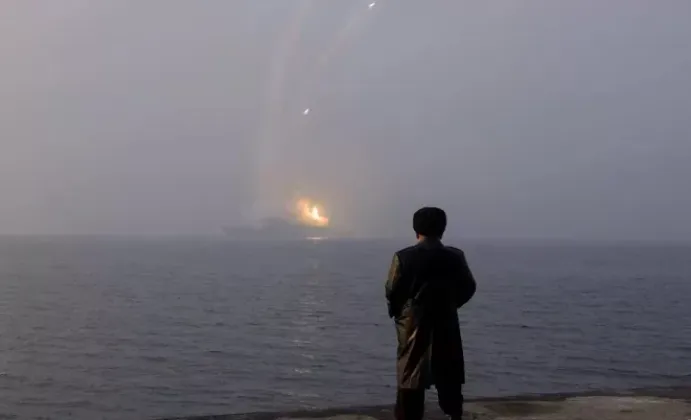
North Korea tested two types of strategic cruise missiles capable of being launched from submarines on Wednesday in waters off its eastern coast, the state-run Korean Central News Agency (KCNA) said. The test was intended to assess the effectiveness of the country’s naval capability and the reliability of its deterrent weapons, according to KCNA. The launch came amid rising tensions with South Korea following a landmine explosion in the border area.
What North Korea said about the test
KCNA described the weapons as strategic cruise missiles that can be launched from submarines and said two types were tested. Its account placed the test in waters off North Korea’s eastern coast. The agency said the purpose was to check both the effectiveness of the naval capability and the reliability of the country’s deterrent weapons. The report did not provide further technical details in the information available about the test.
The announcement therefore presented the launch as a capability check, rather than offering a detailed account of how the missiles performed. KCNA’s stated aims cover two related elements: the ability of the navy to employ the weapons and the dependability of the deterrent systems. The agency did not specify the missiles’ range, flight path, launch platform or other performance measurements in the report summarized by Ratopati.
The distinction between a test’s stated purpose and its publicly disclosed results is important. KCNA reported that the exercise was intended to examine capability and reliability, but the available account does not describe the measurements used or provide independent assessments of the outcome. The report also does not identify the submarines involved or say whether the test included additional weapons or military activity.
Test takes place amid tensions with South Korea
The missile test came as tensions between North Korea and South Korea were rising after a landmine explosion in the border area. The timing links the announcement to an already strained period between the two countries, although the information provided does not say that the explosion prompted the test or that the launch was a direct response to South Korea. KCNA’s explanation focused instead on evaluating North Korea’s naval capability and deterrent weapons.
The border incident and the weapons test are distinct developments, but their proximity adds to the significance of the announcement. The landmine explosion has become a source of tension between the two Koreas, while North Korea’s statement describes a military exercise involving strategic weapons. No further details about the explosion, its circumstances or the parties’ responses are included in the available account, so its precise connection to the missile test remains unclear.
KCNA’s description also indicates how North Korea framed the exercise: as a test of military readiness and the reliability of its deterrent. That framing is the state news agency’s account of the purpose, not a detailed explanation of the wider political or military implications. The report does not provide a response from South Korea, nor does it say whether the test changed the posture of either country.
The reported launch adds to a period of heightened tension, but the available information leaves key questions unanswered. It confirms that North Korea said it tested two submarine-launchable strategic cruise missile types off its eastern coast on Wednesday and identifies the objectives claimed by KCNA. It does not provide technical results, independent verification or details about any subsequent action by either side.