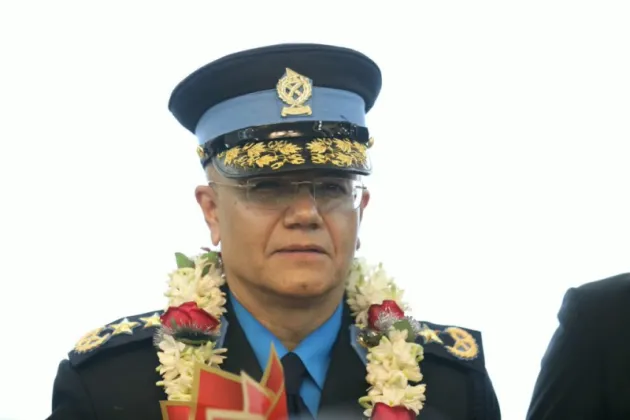
Newly appointed Inspector General of Police Dr. Manoj Kumar KC has pledged to lead a Nepal Police that earns the trust of the people rather than striking fear into them, declaring that rebuilding the public's declining confidence in the force will be the top priority of his tenure. KC delivered the remarks on Wednesday at a function organised at the Ministry of Home Affairs, where he was formally decorated with the insignia of the police chief, assuming leadership of the country's principal law enforcement agency.
'Trust, not fear' as the guiding message
Speaking after receiving his insignia, IGP KC said the police must work to build public trust rather than fear, positioning the restoration of popular confidence as the defining goal of his time in office. According to Thaha Khabar, he identified the task of rebuilding the public's faith in the police, which he acknowledged has been on the decline, as the foremost responsibility before the institution under his command.
The remarks, delivered at the insignia handover ceremony at the Home Ministry, were carried by major Nepali news portals including Nepal Press and News of Nepal, all of which highlighted the new chief's emphasis on public confidence as the centrepiece of his agenda.
KC's framing of the police as an organisation that should inspire trust rather than fear sets a clear tone for his stewardship of the force. By making public trust the yardstick of his leadership from the outset, he has effectively committed the institution to winning back the confidence of the very citizens it is mandated to serve, and he has done so at the earliest possible moment, in his first public remarks after receiving the police chief's insignia.
Cyber fraud, crypto and trafficking top the list of challenges
Alongside his message on public confidence, the new IGP set out the operational challenges he wants the force to confront as a matter of priority. He named the following areas:
- Crime control
- Cyber fraud
- Cryptocurrency transactions
- Drugs
- Human trafficking
KC said these challenges would be addressed with priority during his tenure. The list is notable for pairing traditional policing concerns such as crime control, drugs and human trafficking with newer, technology-driven threats, namely cyber fraud and cryptocurrency transactions, signalling that the force under his command is expected to respond to both conventional and emerging forms of criminal activity.
By naming these five areas explicitly at the start of his tenure, KC has given both the public and the police rank and file a clear indication of where the institution's operational focus is expected to fall in the period ahead. The breadth of the list, spanning offences on the street and offences that increasingly play out in digital spaces, underscores the scale of the operational agenda the new chief has set for himself and for the organisation he now leads.
Pledges on autonomy and freedom from party influence
Among the most consequential commitments made at Wednesday's function was KC's pledge to keep the police operationally autonomous and free from the influence of political parties. According to Nepal Press, the newly appointed IGP demanded operational autonomy for the police and freedom from partisan influence, underscoring his position that the force should function as a professional institution.
The assurance places the emphasis on policing decisions being taken on professional and operational grounds rather than at the direction of political actors. KC's pledge that the force will remain beyond the reach of party influence stands alongside his promise of public trust as one of the two central commitments with which he has opened his tenure as police chief, and together the two pledges sketch the kind of institution he says he intends to head: one that is credible in the eyes of citizens and independent in the conduct of its duties.
The road ahead
The handover of the insignia at the Ministry of Home Affairs formally marks the beginning of KC's stewardship of the Nepal Police. He takes charge with a clearly stated agenda on three fronts: rebuilding the public's eroding confidence in the force, prioritising the fight against crime, cyber fraud, cryptocurrency transactions, drugs and human trafficking, and safeguarding the institution's operational autonomy from partisan interference.
With those priorities now public, attention will turn to how the new leadership translates these commitments into practice. For the new police chief himself, however, the measure of success appears straightforward. As he told the gathering at the Home Ministry, the police of his tenure will be one that the people trust, not one they fear.