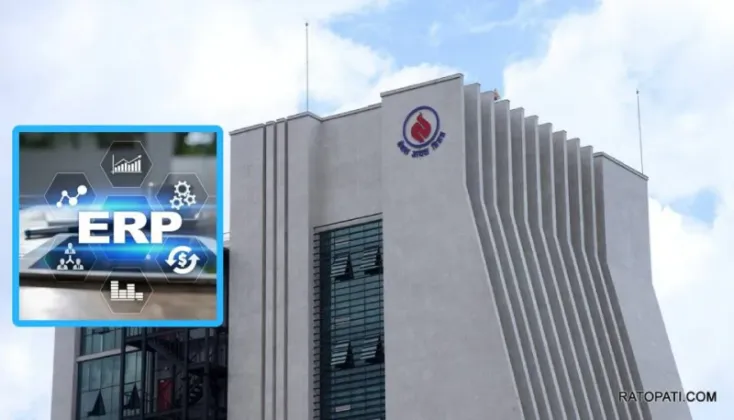
Nepal Oil Corporation's (NOC) Enterprise Resource Planning (ERP) project, one of the state-owned petroleum supplier's most ambitious digitisation efforts, has reached its final stage after about five and a half years of work. According to project chief Pradeep Kumar Yadav, the system, developed at a cost of around Rs 228.7 million, has already completed its first phase of implementation and is now in the process of being fully handed over to the corporation. Once that handover is complete, all of NOC's transactions are expected to run on a single integrated digital platform, fulfilling the core objective the project set out to achieve when it began more than five years ago.
Five and a half years in the making
The ERP initiative was launched with a clearly defined goal: to bring every transaction of the corporation onto one integrated digital system. Reports published by RatoPati and Khabarhub confirm that the project has now arrived at the stage of full handover.
Project chief Pradeep Kumar Yadav has overseen the effort, and according to him the first phase of the system has already been implemented. The length of the project, roughly five and a half years from inception to handover, reflects the scale of what was attempted. Rather than automating a single department, the project was designed to connect the corporation's core functions, from the purchase and movement of petroleum products to financial administration and personnel management, within one common framework.
ERP systems of this kind are built to run an organisation's operations on a shared database, meaning that a transaction recorded in one section becomes immediately available to every other department that relies on it. For a corporation whose daily work spans fuel procurement, distribution, storage and accounting, that integration is the central promise of the platform. At around Rs 228.7 million, the project represents a significant investment in modernising how the corporation manages its internal and external transactions.
First phase covers the corporation's core operations
The implemented first phase is broad in scope. According to Yadav, it covers the following areas of the corporation's work:
- Petroleum product purchase: the procurement of fuel is now recorded digitally, placing the corporation's buying activity on the integrated system.
- Sales and distribution: the sale and onward distribution of petroleum products have been brought within the same platform, linking what the corporation buys with what it sells.
- Storage: the storage of petroleum products is tracked on the system, giving the corporation a digital record of stock held across its operations.
- Finance and accounts: financial and accounting functions are integrated into the ERP, tying the corporation's monetary records directly to its operational activity.
- Employee management: personnel administration has also been digitised as part of the first phase.
Taken together, these modules mean that the corporation's most fundamental activities, buying, selling, storing, accounting for and staffing its petroleum business, are already running on the integrated system. The first phase therefore laid the operational foundation on which the rest of the project now stands, covering the full chain from purchase through distribution to financial reconciliation.
The handover phase
With the first phase in place, the project has moved into what Yadav describes as the phase of full handover. In practical terms, this is the stage at which a completed system is transferred into the ownership and operation of the organisation that commissioned it, closing out the implementation period that has run for the past five and a half years.
The handover marks a turning point for the corporation. During implementation, the focus was on building, deploying and stabilising the system across its various modules. Now, the emphasis shifts to the corporation operating the platform as its own, with all of its transactions eventually residing on the single integrated system that the project was created to deliver.
Why a single integrated system matters
The driving idea behind the project has been consolidation. By design, the ERP aims to bring all of NOC's transactions onto one platform rather than leaving them scattered across separate records and processes. With purchase, sales, distribution, storage, finance, accounts and employee management already covered in the first phase, the corporation's operational and financial data sit within a single framework.
That kind of integration is what distinguishes an ERP system from standalone digital tools. Because every recorded transaction feeds the same system, the corporation's operational activity and its accounts are directly connected, and the management of personnel is handled alongside the business functions they support. For an organisation handling the purchase, storage, distribution and sale of petroleum products across the country, the value of having all of that activity flow through one system is the central justification for the roughly Rs 228.7 million the project has cost.
The arrival of the project at its final stage closes a chapter that began five and a half years ago. According to project chief Yadav, the system is now in the process of full transfer, and with the first phase already implemented across the corporation's core functions, Nepal Oil Corporation stands on the verge of running its transactions entirely on the single integrated digital platform it set out to build. For the corporation, the completion of the handover will mark the moment the long-running project formally becomes business as usual.