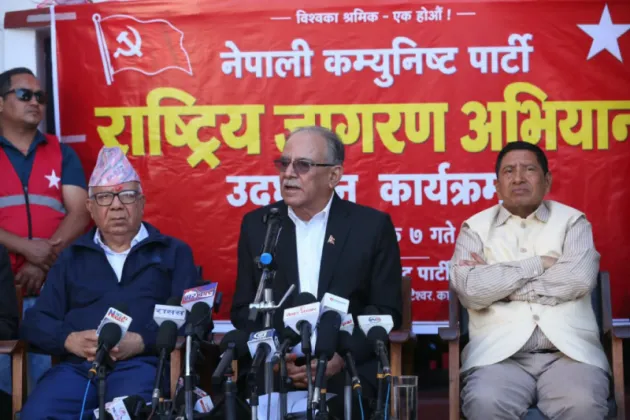
The Nepali Communist Party (NCP) has finalised the main slogans for its two-month National Awakening Campaign, setting the tone for a coordinated nationwide messaging drive. According to a report published by Nepal Press on 4 November, the party has also instructed its committees at various levels to display the slogans on banners during the campaign. The two lines adopted as the campaign's central message are "Oppose authoritarianism and anarchy" and "Protect nationalism and the democratic republic." With the slogans now settled, the party's focus turns to how its committee network carries the message to the public over the next two months.
Two Slogans to Anchor the Campaign
The first slogan, "Oppose authoritarianism and anarchy," delivers a message of resistance. It names two distinct dangers in a single line: authoritarianism, referring to anti-democratic and concentrated rule, and anarchy, referring to disorder and the breakdown of lawful governance. By rejecting both in the same breath, the party is positioning itself against threats to democratic order from either direction.
The second slogan, "Protect nationalism and the democratic republic," is framed as a message of defence rather than opposition. It ties the defence of national interests, expressed through the word nationalism, to the defence of Nepal's republican and democratic system of governance.
Taken together, the pair forms a deliberate construction: one slogan defines what the party stands against, while the other defines what it stands for. The report notes that these two lines have been adopted as the main slogans, which means they will serve as the most prominent and frequently repeated messaging of the entire campaign.
Committees Instructed to Display Banners
Alongside finalising the slogans, the party has issued a practical directive: committees at various levels are to display the slogans on banners during the campaign. This instruction ties the central messaging directly to the party's organisational structure, making each committee responsible for giving the campaign a visible presence in its own area.
The directive carries three clear elements:
- The two finalised slogans, "Oppose authoritarianism and anarchy" and "Protect nationalism and the democratic republic," are to be used as the campaign's main message.
- Committees at various levels of the party are responsible for displaying them.
- The slogans are to appear on banners throughout the two-month campaign period.
Standardising the slogans in this way ensures that whatever else happens during the National Awakening Campaign, the public encounters a single, consistent message wherever the party is active. Banners are among the most visible and enduring forms of political messaging, remaining in place for weeks and reaching everyone who passes by, which makes the display instruction a central part of the campaign's design rather than a minor logistical step.
A Two-Month National Awakening Push
The campaign is set to run for two months, a duration long enough for the slogans to become a familiar feature of the political landscape. Termed the National Awakening Campaign, its name signals an intent to raise political consciousness among the public, with the finalised slogans serving as the distilled message of that effort.
The sequencing announced so far is clear: the slogans have been finalised first, and the committees have been instructed to display them on banners during the campaign. This suggests the banner rollout will be the primary public expression of the campaign as it unfolds over the two-month period, with the party's grassroots presence doing the work of carrying the message into cities, towns and villages alike.
What the Slogans Signal
The language of the two slogans places the party squarely around two themes that run deeply through Nepali politics: nationalism and the defence of the democratic republic. Nepal's system of governance is a democratic republic, and the call to protect it positions the party as a defender of the existing constitutional order rather than a force seeking to change it.
Equally notable is the decision to oppose authoritarianism and anarchy in the same slogan. The pairing implies that the party views threats to democratic governance as coming from more than one direction, both from the concentration of power that undermines democratic norms and from disorder that erodes the functioning of the state. Framing the campaign around opposition to both, while simultaneously calling for the protection of nationalism and the republic, allows the party to present a unified stance without limiting its message to a single adversary.
For the party's committees, the task over the coming two months is now well defined: take the two finalised slogans, put them on banners, and keep them on display for the duration of the National Awakening Campaign. How visibly and consistently that instruction is carried out across the country will shape the public face of the campaign from start to finish.