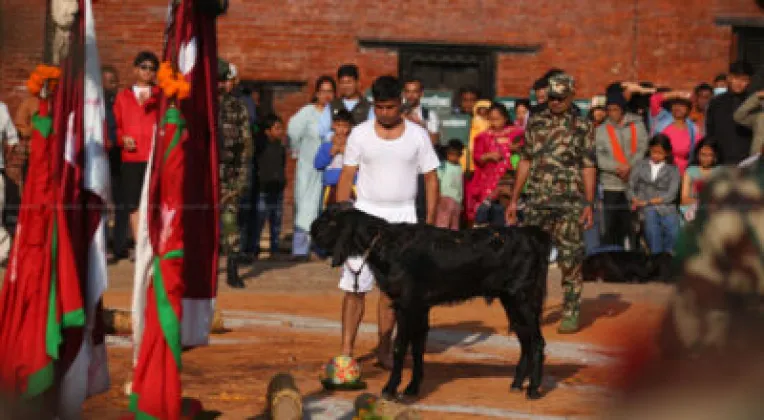
Nepali Army soldiers performed the ritual sacrifice of goats and buffaloes at the main courtyard of Hanuman Dhoka Durbar in Basantapur, Kathmandu, on the day of Maha Navami, one of the most significant days of the Dashain festival. The animals were offered to the deities in keeping with a long-standing custom under which sacrifices are carried out at the historic courtyard on Maha Ashtami, Maha Navami and Chaturdashi, with 54 goats and 54 buffaloes sacrificed each day across the three-day period. The ceremony underscores the central place that ritual worship continues to hold during Dashain, Nepal's largest and most important Hindu festival, which symbolises the victory of good over evil.
Soldiers Carry Out the Ritual at the Historic Courtyard
The sacrifices were performed at the main courtyard of Hanuman Dhoka Durbar, the historic durbar premises located in Basantapur in the heart of Kathmandu. Soldiers of the Nepali Army carried out the offerings, presenting the goats and buffaloes to the deities in line with the custom observed at the site during the festival.
The ceremony on Maha Navami did not stand alone. It formed part of a wider schedule of sacrifices conducted at the courtyard over three days of Dashain, namely Maha Ashtami, Maha Navami and Chaturdashi. According to the tradition followed at Hanuman Dhoka, the same ritual is repeated on each of these days, continuing a practice that has been associated with the durbar courtyard during the festival.
The event was reported by Khabarhub, which noted that the soldiers performed the sacrifices on the day of Maha Navami as part of the continuing tradition at the venue.
54 Goats and 54 Buffaloes Each Day
The scale of the observance at Hanuman Dhoka is fixed by custom. According to the practice, 54 goats and 54 buffaloes are sacrificed daily at the main courtyard across the three days of ritual sacrifice. The schedule is as follows:
- Maha Ashtami: 54 goats and 54 buffaloes are sacrificed at the main courtyard
- Maha Navami: 54 goats and 54 buffaloes are sacrificed, the ritual performed by Nepali Army soldiers this year
- Chaturdashi: 54 goats and 54 buffaloes are sacrificed as the tradition continues
Taken together, the custom involves the sacrifice of 162 goats and 162 buffaloes over the full three-day period. The daily figure of 54 of each animal highlights the scale at which the ritual is observed at the durbar premises, where the offerings are made each day of the three-day window rather than on a single occasion. The animals are offered to the deities as part of the worship associated with these important days of the festival.
The repetition of the same number of sacrifices on each of the three days reflects the fixed nature of the custom, which is carried out in the same courtyard and follows the same pattern year after year. The participation of the Nepali Army in performing the ritual remains a defining feature of the observance at Hanuman Dhoka.
Dashain: The Victory of Good over Evil
Dashain holds a singular position in Nepal's cultural and religious calendar. It is the country's largest and most important Hindu festival, symbolising the victory of good over evil, and it is observed with devotion across the nation. The days of Maha Ashtami and Maha Navami fall within the most intense period of worship during the festival, when offerings are made to the deities in homes, temples and public courtyards.
The sacrifices performed at Hanuman Dhoka are part of this broader atmosphere of worship. The offering of goats and buffaloes to the deities, as carried out by the soldiers on Maha Navami, is among the rituals associated with these days, and the durbar courtyard serves as one of the most prominent settings for the observance in the capital.
For devotees, the symbolism at the heart of Dashain, the triumph of good over evil, gives rituals such as these their religious meaning. The offerings made at the main courtyard of Hanuman Dhoka are therefore not isolated ceremonies but expressions of the festival's central themes, enacted at a site that has long been tied to the observance of Dashain in Kathmandu.
A Custom Repeated Through the Festival
The tradition at Hanuman Dhoka is defined by repetition and continuity. The same offerings, in the same numbers, are made on each of the three days of sacrifice, and the ritual is performed at the same main courtyard of the durbar. The Nepali Army's role in carrying out the ceremony on Maha Navami once again this year demonstrates how the practice is maintained through the festival period.
With the Maha Navami sacrifices complete, the custom at the courtyard is set to continue through Chaturdashi, the third of the three days on which the tradition is observed. For the soldiers who perform it and the devotees who regard the days as among the holiest of the festival, the ritual remains an enduring part of how Dashain is marked at one of Kathmandu's most historic sites.
The continuation of the practice year after year, on Maha Ashtami, Maha Navami and Chaturdashi alike, reflects the weight that tradition carries at Hanuman Dhoka, where the offerings of 54 goats and 54 buffaloes each day remain a fixed and familiar feature of the festival.