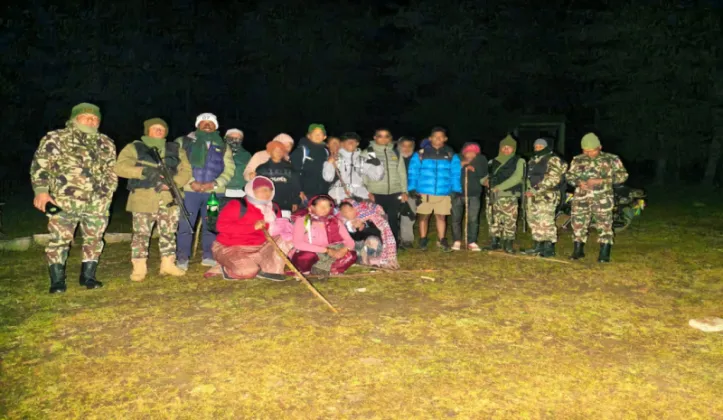
The Nepali Army has rescued 12 domestic tourists who lost their way and became stranded in the dense Chuchchemara forest of Chhayanath Rara Municipality-8 in Mugu district. The rescue was carried out at night, at around 10 pm, by a team from the Hanumandhwar-based unit of the Nepali Army, according to reports published by Gorkhapatra Daily and Pradesh Khabar. The tourists had traveled to Mugu, in Karnali Province, with the aim of visiting Rara Lake, one of Nepal's most celebrated natural attractions, before losing their bearings in the forest.
A Late-Night Operation in Chuchchemara Forest
The group, which had come to Mugu to visit Rara Lake, lost their way inside the Chuchchemara forest, which falls under Ward 8 of Chhayanath Rara Municipality. The woodland there is thickly vegetated, and visitors who stray from established trails can quickly become disoriented, particularly after nightfall. That is the situation the 12 tourists found themselves in, unable to make their way out of the forest on their own.
After the group was reported stranded, the Hanumandhwar-based army unit mobilized a rescue team. Moving through the forest at night, the soldiers located the tourists and brought them safely out of the area, with the operation carried out at around 10 pm. All 12 members of the group were rescued.
Key details of the rescue as reported:
- Who was rescued: 12 domestic tourists
- What happened: The group lost their way and became stranded in the dense forest
- Where: Chuchchemara forest, Chhayanath Rara Municipality-8, Mugu district
- When: At night, at around 10 pm
- Rescue team: Personnel from the Hanumandhwar-based unit of the Nepali Army
The reports did not specify how long the tourists had been stranded, how the army was alerted, or whether anyone required medical attention after being brought out of the forest.
The Draw of Rara Lake
The tourists had come to see Rara Lake, the largest lake in Nepal and the centerpiece of Rara National Park in Mugu district. Sitting at an altitude of roughly 2,990 meters, the lake is ringed by pine-covered ridges and open meadows and is widely regarded as one of the most beautiful spots in the country. For domestic travelers in particular, a trip to Rara is often considered a once-in-a-lifetime journey, and the lake has become the flagship attraction of tourism in Karnali Province.
Chhayanath Rara Municipality administers the area around the lake, and its forested terrain, including the Chuchchemara forest, forms part of the landscape through which visitors pass on their way to the water. Because much of the journey involves moving through dense woodland, the area around the lake can be difficult to navigate for those unfamiliar with the trails.
An Incident That Highlights the Challenges of Remote Travel
The episode underscores the practical difficulties of visiting remote destinations in districts like Mugu, where road access is limited and tourist sites lie far from major settlements. Dense forests, unmarked paths and long distances between villages mean that even a short excursion can turn risky when daylight fades. The experience of the 12 tourists in Chuchchemara forest illustrates how quickly a much-anticipated trip can turn into an ordeal in such terrain.
Incidents of this kind also point to precautions that are commonly advised for travelers heading to the Rara region, including moving with local guides, informing hosts or local authorities of travel plans, and avoiding travel through forested areas after dark. The dense woodland surrounding the lake, scenic as it is, demands caution from visitors exploring it for the first time.
The Army's Role in Remote-Area Rescue
The Nepali Army maintains units across Nepal's remote districts, and its personnel are routinely called upon for search and rescue when travelers, trekkers or locals go missing in difficult terrain. The night operation in Chuchchemara forest by the Hanumandhwar-based unit is the latest example of that role. Searching for a stranded group in dense woodland after dark is among the most demanding forms of rescue work, requiring familiarity with the ground and the ability to navigate without the benefit of daylight.
For the 12 tourists rescued in Mugu, the operation brought a frightening episode to a safe conclusion. Brought out of the forest at around 10 pm, the group avoided what could otherwise have been a long and dangerous night in the wilds of one of Nepal's most remote districts, thanks to the prompt response of the army team deployed at Hanumandhwar.