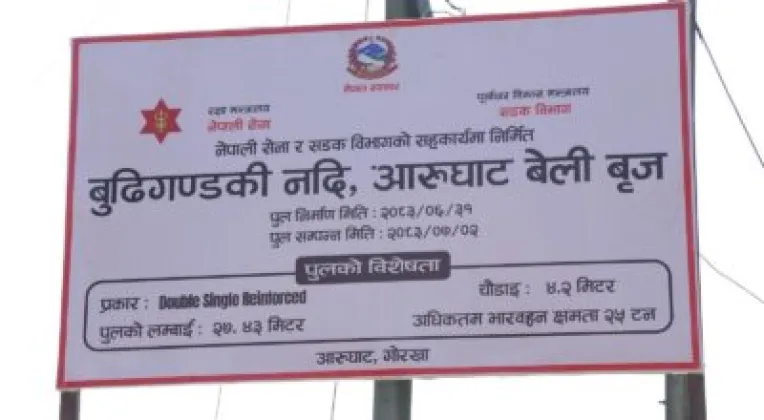
The Nepali Army has completed the installation of a 27.43-meter-long Bailey bridge over the Budhi Gandaki River at Aarughat, re-establishing a vital crossing point between Dhading and Gorkha districts in a span of just two days. According to the Army's Directorate of Public Relations and Information, the newly completed bridge was handed over to the Gorkha Road Project on Monday, bringing a rapid engineering operation at one of the region's key river crossings to a formal close.
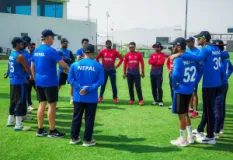
The installation work was carried out entirely by the Nepali Army, whose engineers assembled the steel structure across a river known for its powerful flow and difficult banks. News of the completion and handover was disseminated through the Directorate, the Army's official communication wing, and picked up by national outlets including Khabarhub and My Republica.
A Rapid Engineering Operation
Bailey bridges are prefabricated, modular steel bridges that can be transported in components and assembled on site, often without the need for heavy cranes. This makes them particularly suited to Nepal's mid-hills, where road access can be limited and river valleys are difficult to reach with large construction equipment. The Nepali Army has built extensive experience with such structures over the years, and the Aarughat installation is the latest demonstration of that capability being put to practical use.
The key facts of the operation are as follows:
- The bridge measures 27.43 meters in length and spans the Budhi Gandaki River at Aarughat.
- The structure connects Dhading district with Gorkha district.
- The Nepali Army completed the entire installation within two days.
- The completed bridge was handed over to the Gorkha Road Project on Monday.
The two-day timeline stands out because it reflects not only the assembly of the span itself but also the planning and coordination that such an operation demands. For a bridge of this length over a major river, a compressed schedule of this kind highlights the readiness and discipline of the Army's engineering teams, who are often called upon at short notice to restore links where civilian construction capacity is limited or where timing is critical.
Reconnecting Dhading and Gorkha
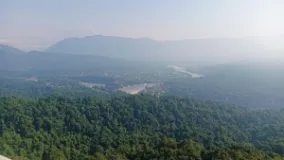
The Budhi Gandaki is one of the significant rivers of central Nepal, and its gorge separates Dhading and Gorkha districts for long stretches of its course. Aarughat, situated along the river, is a key point where the two sides meet, and the crossing there carries local traffic between the districts. The condition of the crossing can effectively determine whether vehicles, goods and travelers are able to move between the two sides at any given time.
In terrain of this kind, the absence of a reliable bridge can leave communities on either bank cut off from one another, forcing long detours or hazardous river crossings on foot. A functioning span at Aarughat keeps markets, schools, health facilities and administrative centers within practical reach for people living on both sides of the river, and it supports the routine movement of supplies that households and businesses in the area depend upon.
The Army's Role and the Handover
The Nepali Army has long been tasked with constructing and restoring infrastructure in areas where road links are fragile or where natural events such as floods and landslides disrupt transport. Bridge installation is among the force's most visible engineering roles, and its teams have repeatedly deployed across the country to erect crossings in difficult locations. The Aarughat operation fits squarely within that tradition, combining military engineering skills with the practical demands of keeping remote communities connected.
With the work complete, responsibility for the bridge now formally rests with the Gorkha Road Project, which received the structure on Monday. The handover marks the transition of the crossing from an active construction site to an operational piece of the local road network, allowing the project authority to manage its use going forward.
For residents of Dhading and Gorkha, the arrival of the bridge at Aarughat is expected to restore a dependable connection across the Budhi Gandaki, one whose value will be measured not in the two days it took to build, but in the daily journeys it enables in the years ahead. The Army's Directorate of Public Relations and Information, in announcing the completion, underscored both the speed of the installation and the seamless transfer of the structure to the road project, closing out an operation that briefly brought the focus of the country's infrastructure story to a quiet bend of the Budhi Gandaki.